
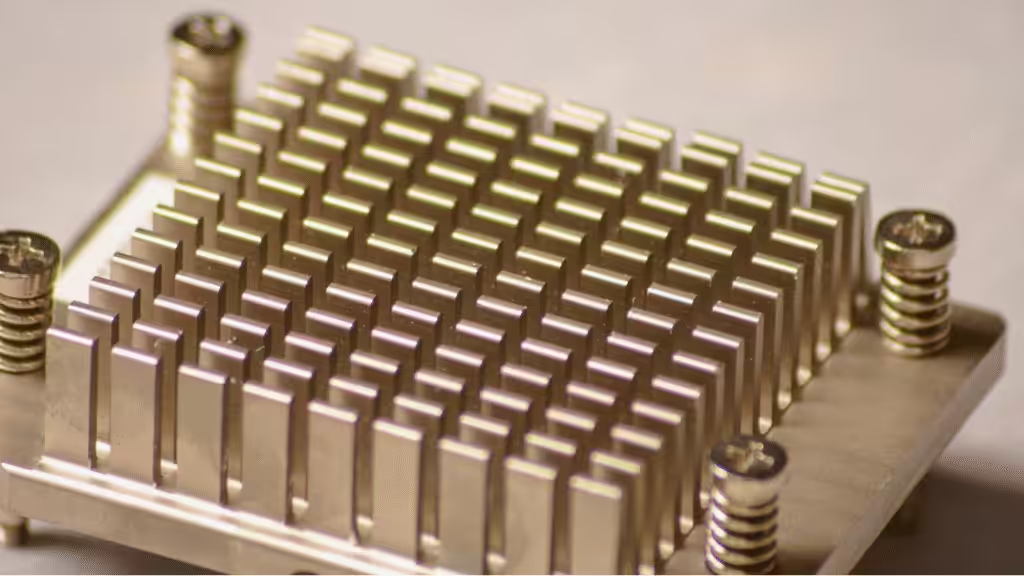
Whether your BOM calls it a heat sink or a heatsink, the best brand is the one that can prove its design at your real heat load, airflow, mounting pressure, and production volume. A famous logo does not lower junction temperature. Physics remains stubbornly unimpressed by brand awareness.
This guide compares 10 established heat sink brands for professional electronics cooling. The list covers board-level heat sinks, extruded aluminum profiles, skived and bonded-fin designs, fan-cooled assemblies, power-electronics coolers, heat pipes, and liquid cold plates.
The ranking is aimed at engineers, sourcing teams, and OEM buyers. It is based on publicly documented product breadth, engineering support, technical data, manufacturing options, distribution access, and fit for real production programs as of July 2026. It is not a market-share table or a claim that one supplier wins every project.
Top 10 Heat Sink Brands at a Glance
| Rank | Heat sink brand | Best fit | Main strength |
|---|---|---|---|
| 1 | Boyd Thermal, now part of Eaton | Enterprise and high-power programs | Broad air-to-liquid cooling portfolio |
| 2 | Wakefield Thermal | Standard and custom industrial cooling | Deep catalog plus in-house thermal extrusion |
| 3 | Advanced Thermal Solutions | PCB, edge AI, and engineering-led projects | Heat sinks, attachment systems, testing, and design tools |
| 4 | Seifert electronic | European industrial and custom profiles | Extruded, modular, forced-air, and skived heat sinks |
| 5 | Mecc.Al | Medium- and high-power electronics | Wide air-cooled and liquid-cooled manufacturing range |
| 6 | Radian Thermal Products | BGA, PCIe, and custom microelectronics | Standard catalog plus custom thermal engineering |
| 7 | Ohmite | Power semiconductors and power resistors | Package-specific heat sinks and tool-free clips |
| 8 | D6 Industries | High-power custom assemblies | Bonded-fin heat sinks and cold plates |
| 9 | Cool Innovations | Omnidirectional airflow and passive cooling | Specialized pin-fin and fan-sink portfolio |
| 10 | Same Sky | Distributor-friendly board-level sourcing | Parametric selection, CAD data, and standard availability |
Use the table as a shortlist, not as a purchase order. The final choice still depends on thermal resistance, pressure drop, envelope, mounting, compliance, annual volume, and the supplier’s ability to hold those requirements after the golden sample has retired from public life.
How We Ranked These Heat Sink Brands
We evaluated each brand across six practical areas:
- Heat sink portfolio: Standard extrusions, board-level parts, skived fins, bonded fins, active coolers, heat pipes, vapor chambers, and cold plates.
- Published engineering data: Drawings, thermal resistance values, airflow conditions, CAD models, selectors, and application notes.
- Custom engineering: DFM support, simulation, tooling, machining, finishing, assembly, and validation.
- Production readiness: Manufacturing range, quality controls, traceability, compliance, and ability to move from prototype to repeat orders.
- Procurement access: Distributor stock, direct quotation paths, catalogs, samples, and regional support.
- Application fit: How clearly the brand serves PCB cooling, power electronics, AI hardware, telecom, industrial controls, transport, or other demanding markets.
This method favors evidence over adjectives. “High performance” is useful only when the supplier also tells you what was tested, how air moved, where temperature was measured, and whether your mounting stack resembles the test fixture.
1. Boyd Thermal, Now Part of Eaton

Best for: Large OEM programs that may need to move from a conventional heat sink to heat pipes, liquid cooling, or a complete thermal system.
Boyd has one of the broadest documented thermal portfolios in this list. Its heat sink capabilities cover aluminum extrusions, bonded and brazed fins, folded and zipper fins, skived heat sinks, die-cast parts, and fan-assisted assemblies. That range helps when a project starts with air cooling but later discovers that the hot spot did not read the original project plan.
Its standard extrusion library can reduce tooling time, while custom bases can add machining, embedded heat pipes, vapor chambers, graphite spreaders, or application-specific mounting features. This makes Boyd a strong candidate for data-center hardware, power conversion, aerospace, transportation, medical equipment, and industrial systems.
There is one current sourcing detail to note. Eaton completed its acquisition of Boyd Thermal in March 2026. Buyers should confirm the current contracting entity, approved manufacturing location, part-number continuity, and support channel during qualification.
What to verify before RFQ: Ask which technology and manufacturing site will support your project, who owns custom tooling, how change control works after the Eaton transition, and whether the quoted thermal result includes your fan curve and system impedance.
2. Wakefield Thermal
Best for: Engineers who want a broad standard catalog, domestic extrusion options in the United States, and a path into custom air or liquid cooling.
Wakefield Thermal covers board-level semiconductor heat sinks, BGA coolers, DC/DC converter solutions, power-module coolers, extrusion profiles, skived fins, heat pipes, cold plates, fans, and thermal interface materials. Its board-level heat sink range includes familiar package and mounting options, which is useful when the PCB is already crowded and the mounting method cannot become a side quest.
The company also publishes a substantial technical literature library with product brochures, data sheets, thermal extrusion information, BGA selection material, and cold-plate references. That documentation helps engineers compare existing parts before paying for custom tooling.
Wakefield is especially relevant for industrial controls, embedded computing, power electronics, defense, and programs that value North American extrusion capacity. It can support a progression from standard profile selection to machining, finishing, heat-pipe integration, or liquid cooling.
What to verify before RFQ: Confirm whether a published thermal value is for natural convection or a stated airflow, whether the air is ducted, and whether attachment hardware and TIM are included. Also request the exact extrusion, machining, and finishing sites for your production plan.
3. Advanced Thermal Solutions
Best for: PCB, FPGA, edge-AI, and lab-heavy projects where thermal design support matters as much as the metal.
Advanced Thermal Solutions, usually shortened to ATS, combines heat sinks with attachment systems, thermal instruments, wind tunnels, heat pipes, vapor chambers, cold plates, and consulting. Its extruded heat sink range includes straight-fin, slant-fin, pin-fin, and LED profiles, with standard component footprints and customizable lengths.
ATS stands out for the surrounding engineering ecosystem. The company offers heat sink selectors, test equipment, design services, and package-specific solutions for embedded computing platforms. Its attachment portfolio includes push pins, clips, tape, maxiGRIP, and superGRIP options. That matters because a low thermal resistance in a PDF can vanish quickly when the clip applies uneven pressure or the TIM bond line doubles.
This brand is a strong fit for development teams that want to model, test, and iterate before committing to high-volume tooling. It also suits buyers who prefer standard, distributor-supported parts for early builds.
What to verify before RFQ: Match the heat sink data to the exact attachment, orientation, airflow, and component height. If ATS will simulate the system, define what must be correlated in physical testing and which input data remain your responsibility.
4. Seifert Electronic

Best for: European industrial programs that need custom extruded profiles, forced-air coolers, skived fins, or ready-to-install machined assemblies.
Seifert electronic has focused on electronics cooling for more than 50 years. Its heat sink portfolio runs from small transistor coolers to large profile heat sinks for IGBT applications. The company supports natural convection, forced cooling, special profiles, liquid heat sinks, machining, surface treatment, assembly, and inspection.
Seifert is also expanding beyond conventional extrusion. Its Flexfin skived heat sinks use one-piece aluminum or copper construction with thin fins and tight spacing. Skiving can offer more fin density without a bonded joint, which is useful when extrusion geometry becomes the bottleneck.
The brand fits renewable energy, rail, industrial converters, laser systems, LED equipment, and power electronics. Its standard range can shorten development, while configurable and custom profiles support unusual envelopes.
What to verify before RFQ: Define the expected airflow direction and pressure drop before selecting dense fins. Ask whether the design uses a catalog profile, a configurable profile, or dedicated tooling, because those paths have different minimum quantities, lead times, and ownership rules.
5. Mecc.Al

Best for: Medium- and high-power systems that need a broad choice of air-cooled manufacturing methods plus an upgrade path to liquid cooling.
Mecc.Al designs and manufactures heat sinks for industrial electronics, telecom, renewable energy, electric mobility, and data-center systems. Its air-cooled portfolio includes extruded, welded, modular high-performance, skived, brazed-fin, and bonded-fin solutions.
This breadth is useful because no single process owns every thermal problem. Extrusion is economical for repeatable constant sections. Welding can create wider structures. Skiving supports thin, dense fins. Bonded or brazed assemblies provide more freedom in base and fin geometry. Mecc.Al also produces liquid-cooled plates using several joining methods when air cooling stops making the numbers behave.
The company’s published production capabilities include cutting, deburring, CNC machining, multiple welding and brazing processes, washing, surface treatment, thermal simulation, and dimensional measurement. For an OEM, that can reduce the number of suppliers touching a critical thermal assembly.
What to verify before RFQ: Ask which manufacturing route was selected and why. Compare interface resistance, fin retention, corrosion control, cleaning, flatness, and validation requirements across extruded, assembled, welded, and liquid-cooled options.
6. Radian Thermal Products
Best for: BGA, PCIe, networking, embedded computing, and custom microelectronics cooling.
Radian Thermal Products combines a practical standard catalog with custom engineering. Its official product range includes clip-on BGA heat sinks, push-pin designs, plate fins, round pins, elliptical fins, PCIe coolers, fan sinks, heat pipes, and vapor chambers.
Radian is a useful shortlist candidate when engineers need real selector data rather than a generic extrusion drawing. Its standard products can shorten prototype cycles, while custom services cover CAD, CFD, FEA, machining, finishing, and thermal testing. The current public catalog also provides package dimensions, mounting options, and thermal data across airflow conditions for many board-level families.
The brand is particularly relevant when component keep-out space, clip access, PCIe height, or airflow direction drives the design. A round-pin sink may tolerate changing airflow direction better than a straight-fin profile. A low-profile PCIe cooler may solve the envelope but require more airflow. Every gain sends an invoice somewhere.
What to verify before RFQ: Check chip clearance, PCB keep-out, clip or push-pin force, TIM thickness, airflow test conditions, and removal requirements. For custom products, ask how first-article measurements and thermal correlation will be reported.
7. Ohmite
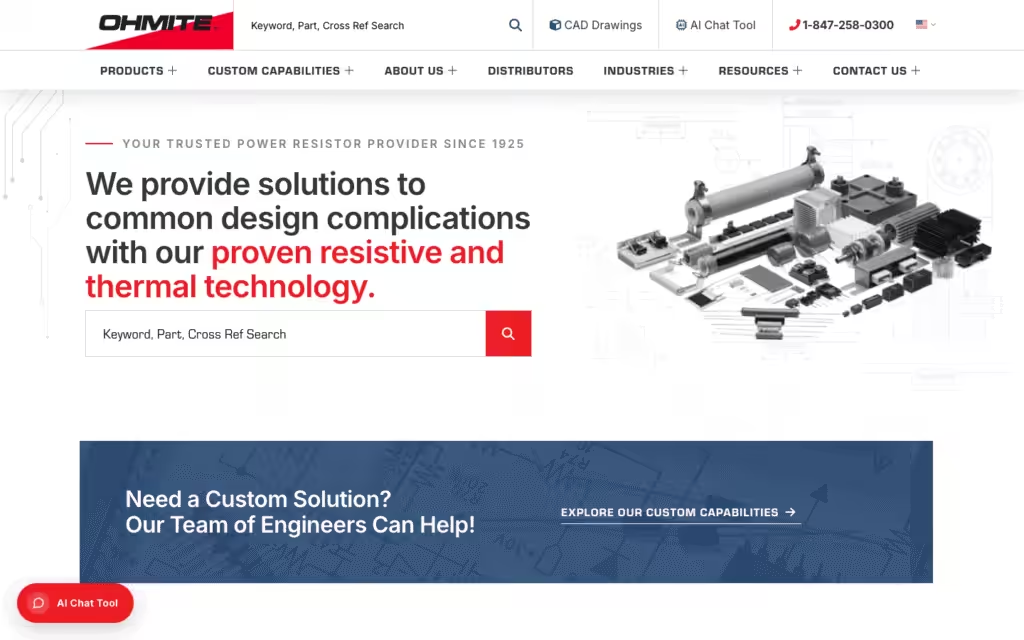
Best for: TO-220, TO-247, DPAK, power resistors, and other high-power discrete devices that need simple, repeatable assembly.
Ohmite is widely known for power resistors, but its industrial heat sink range is substantial. It includes surface-mount heat sinks, package-specific extrusions, BGA products, LED coolers, thermal interface materials, larger custom profiles, and several patented clip systems.
The package focus makes Ohmite useful for power supplies, motor drives, inverters, braking systems, industrial controls, and compact power electronics. Several series use clips to avoid screws, washers, tapped holes, and loose hardware. That can reduce assembly labor and improve clamping consistency, provided the device tolerance and clip force are validated together.
Ohmite publishes product-level thermal resistance, material, finish, package compatibility, dimensional drawings, and mounting details. Its catalog and distributor network also make standard parts easier to sample than a fully custom extrusion.
What to verify before RFQ: Check whether the thermal graph assumes natural or forced convection, how many devices share the profile, and whether quoted resistance includes the interface. Validate clip force, electrical isolation, shock, vibration, and rework before approving a screw-free assembly.
8. D6 Industries

Best for: High-power air-cooled or liquid-cooled assemblies that need custom engineering and low-to-medium-volume flexibility.
D6 Industries focuses on power-electronics thermal management. Its public portfolio includes standard and custom air-cooled heat sinks, bonded-fin designs, liquid cold plates, heat exchangers, and integrated cooling assemblies.
Bonded-fin heat sinks are valuable when an extrusion cannot provide enough width, fin height, or fin density. The base and fins can be configured separately, allowing designers to adjust material, spacing, flow channels, and machining features. The trade-off is that the joint becomes part of the thermal and reliability model.
D6 is a strong candidate for power conversion, test equipment, industrial drives, defense programs, and applications where the cooling hardware must arrive as an assembly rather than a pile of optimistic components.
What to verify before RFQ: Ask how fins are joined, how joint integrity is inspected, what temperature and environmental limits apply, and whether fan, shroud, TIM, fasteners, and cold-plate fittings are included. Define leak testing and cleanliness requirements early for liquid-cooled parts.
9. Cool Innovations

Best for: Pin-fin heat sinks, natural convection, omnidirectional airflow, and compact fan-sink applications.
Cool Innovations is a specialist rather than a broad thermal conglomerate. The company focuses on pin-fin heat sinks and fan sinks for datacom, telecom, medical, lighting, military, and power applications. Its company profile describes a broad pin-fin portfolio with parts that can be modified for specific applications.
Pin fins can work well when airflow direction varies or when natural convection must function across more than one orientation. Cool Innovations offers aluminum and copper options, multiple footprints, attachment methods, and flared-pin geometries. This makes the brand worth checking before defaulting to another straight-fin extrusion.
Specialization is the advantage here. It is also the boundary. If the project needs large bonded fins, a complex liquid loop, or a global multi-technology program, another supplier may be a better lead contractor.
What to verify before RFQ: Compare the data at your mounting orientation, altitude, and airflow. Check base flatness, pin clearance, finish, TIM area, attachment method, and whether nearby components block the natural-convection plume.
10. Same Sky
Best for: Fast selection and distributor-supported sourcing of standard board-level heat sinks.
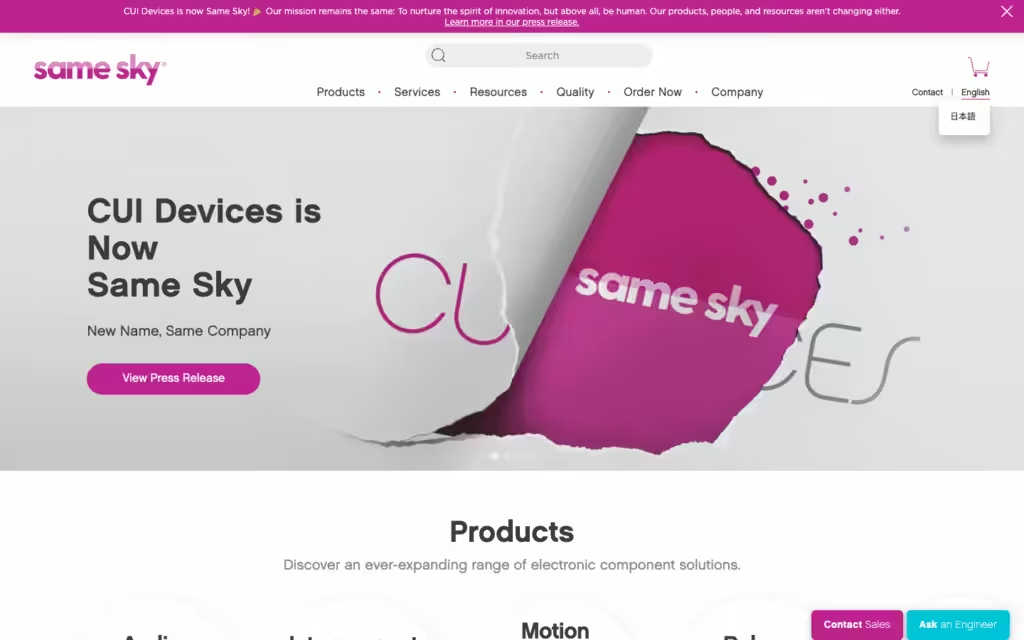
Same Sky is the current name of CUI Devices. Its heat sink range is useful for designers who want parametric filtering, CAD files, PCB footprints, distributor stock checks, and package-level technical data. The extruded heat sink catalog includes dozens of board-level aluminum parts with mounting, dimensions, natural-convection performance, and forced-air values.
The catalog suits TO-package devices, compact PCB cooling, prototypes, and programs that prioritize standard availability. Same Sky also offers custom thermal solutions across heat sinks, fans, and thermoelectric products.
Same Sky ranks lower here because its public heat sink range is more board-level and component-oriented than the large custom portfolios higher in the list. That is not a quality judgment. It is a scope judgment. A tidy standard part can beat an elaborate custom program when schedule and volume say so.
What to verify before RFQ: Confirm lifecycle status, distributor inventory, CAD revision, mounting hardware, finish, and test conditions. The company rebranded from CUI Devices in 2024, so check both names in legacy BOMs and approved-vendor records.
Which Heat Sink Brand Should You Choose?
Start with the application, not the ranking.
Choose Boyd Thermal/Eaton, Wakefield Thermal, or Mecc.Al when you need broad process coverage and may cross from air cooling into heat pipes or liquid cooling.
Choose ATS or Radian when board-level geometry, attachment, published selectors, and engineering iteration dominate the project.
Choose Seifert electronic for European industrial sourcing, custom profiles, forced-air modules, and skived designs.
Choose Ohmite or Same Sky when a standard, package-specific heat sink and distributor access can solve the problem without custom tooling.
Choose D6 Industries for custom bonded-fin or liquid-cooled power assemblies.
Choose Cool Innovations when pin-fin geometry and multidirectional airflow are central to the design.
Then compare suppliers under the same boundary conditions. Do not place a 200 LFM value beside a natural-convection value and call the lower number the winner. That is not benchmarking. That is spreadsheet cosplay.
Heat Sink Supplier RFQ Checklist
A useful RFQ should include:
- Heat source dimensions, location, power dissipation, and heat-flux map
- Maximum junction or case temperature
- Minimum and maximum ambient temperature
- Available airflow, fan curve, pressure drop, and flow direction
- Maximum heat sink width, length, height, and mass
- Component and PCB keep-out zones
- Mounting method, fastener torque, clip force, and service requirements
- TIM type, thickness, compression, and electrical isolation needs
- Shock, vibration, corrosion, altitude, contamination, and ingress conditions
- Required alloy, finish, flatness, roughness, and cosmetic limits
- Prototype quantity, annual volume, ramp schedule, and target cost
- Required simulation, first-article, dimensional, thermal, and reliability reports
- Tool ownership, tool maintenance, revision control, and end-of-life terms
- Packaging, labeling, traceability, compliance, and approved production location
Ask each heat sink manufacturer to state assumptions and exclusions beside the quotation. A clean price without boundary conditions is not clean. It is merely well dressed.
How to Compare Heat Sink Samples Fairly
Test all samples with the same heat source, TIM, mounting pressure, orientation, airflow, inlet temperature, ducting, and instrumentation. Record pressure drop and fan operating point, not just nominal fan CFM.
Measure the base near the heat source, the fin field, inlet air, and outlet air. If the base is hot while outer fins stay cool, heat spreading may be the limit. If the whole sink is warm but airflow barely rises, convection may be the limit. If repeated assemblies vary, the mounting stack may be the real culprit.
For a deeper selection workflow, read Aluminum Heatsinks: Types, Function, and Efficiency Explained. Our guide to the Top 10 Extruded Aluminum Heat Sinks for Precision Cooling compares design families rather than manufacturers. You can also review Why Extruded Aluminum Heat Sinks Outperform Others before choosing between extrusion, skiving, bonded fins, or liquid cooling.
Frequently Asked Questions
What is the best heat sink brand?
There is no universal best heat sink brand. Boyd Thermal/Eaton is a strong option for broad enterprise thermal programs, Wakefield offers a deep standard and custom range, ATS is strong in engineering-led PCB cooling, and specialists such as D6 or Cool Innovations may fit particular high-power or pin-fin applications better.
Are expensive heat sinks always better?
No. A larger or more complex heat sink may add cost, weight, and pressure drop without improving the real thermal bottleneck. Compare thermal resistance under the same airflow, then validate the complete assembly.
Should I buy a standard heat sink or request a custom design?
Start with a standard heat sink when its envelope, mounting, and thermal performance fit with reasonable margin. Choose custom design when a standard part wastes space, blocks airflow, needs heavy secondary machining, or cannot meet mechanical and thermal requirements.
What thermal data should a heat sink manufacturer provide?
Request dimensional drawings, material and finish specifications, thermal resistance with stated airflow and orientation, pressure-drop data when relevant, attachment details, CAD files, test setup, tolerances, and first-article requirements.
Is aluminum or copper better for a heat sink?
Copper spreads heat better, but it costs and weighs more. Aluminum is easier to extrude and often offers the best balance for production. Hybrid designs use copper, heat pipes, or vapor chambers only where spreading resistance justifies them.
When should I move from a heat sink to liquid cooling?
Consider liquid cooling when air cooling cannot meet the required thermal resistance within the allowed size, noise, airflow, or inlet-temperature limits. High heat flux, sealed enclosures, remote heat rejection, and dense multi-chip systems are common triggers.
Final Recommendation
Build a shortlist of two or three heat sink brands that match your process, geography, volume, and application. Send the same RFQ package to each. Review their assumptions, not just their renderings. Then test the finalists in the real assembly.
The winning supplier is not necessarily the one with the lowest catalog thermal resistance or the largest factory photograph. It is the one that can explain the thermal path, manufacture it repeatedly, document the result, and still answer the phone when revision C arrives with two more connectors in the airflow path.
We support custom thermal projects across extruded and machined heat sinks, skived fins, heat pipes, vapor chambers, liquid cold plates, simulation, and validation. For a useful design review, prepare the heat load, heat-source map, ambient range, airflow data, mechanical envelope, mounting plan, and target volume before requesting a quote.