

Choosing automotive radiator suppliers starts with a clear definition of the part you need and the evidence required to approve it. For an OEM project, that may mean design support, performance validation and a controlled production launch. For an aftermarket business, accurate vehicle coverage, repeatable fitment and dependable replenishment may carry more weight.
A useful shortlist therefore connects each supplier’s offer to your application, order profile and approval process. This guide explains how to compare radiator manufacturers, distributors and sourcing partners, what to request before ordering samples, and how to turn the responses into a purchasing decision.
Start with five essentials: an agreed part specification, cooling performance under defined conditions, relevant quality evidence, a workable supply plan and a complete quotation.
Start with the Right Type of Radiator Supplier
The company selling a radiator may manufacture it, distribute an established range or coordinate production through manufacturing partners. Establish those responsibilities early so that technical questions, change approvals and warranty claims reach the right people.
| Supplier route | When it may suit your purchase | What to establish |
|---|---|---|
| Radiator manufacturer | A new design, a modified assembly or a production programme requiring direct process involvement | Which operations it performs, where production takes place and who owns design approval |
| Aftermarket brand or distributor | Purchasing existing references across multiple vehicle applications | Catalogue accuracy, available stock, replenishment arrangements and claim handling |
| Sourcing and engineering partner | Coordinating suppliers, comparing manufacturing routes or consolidating purchases | Manufacturing-site visibility, quality responsibilities, access to technical evidence and change control |
A practical first question is: “Who will manufacture, inspect and release the exact part number we are buying?” Record the answer alongside the commercial contact. If different organisations handle different stages, agree who remains accountable for the delivered assembly.
Define Your Purchase Before Requesting Quotes
Two enquiries for a “car radiator” can require very different responses. Send suppliers a brief that identifies your purchasing route.
| Purchase type | Information to provide first | Main approval question |
|---|---|---|
| Existing replacement radiator | Full OE reference where available, vehicle application, engine, transmission, production period and destination market | Does the offered assembly match the required fitment and performance specification? |
| New OEM or modified design | Controlled drawing, installation envelope, interfaces, duty conditions, validation requirements and volume forecast | Can the proposed design meet the requirements and be produced consistently? |
| Wholesale range expansion | Target vehicle coverage, reference list, expected order mix, packaging and replenishment needs | Can the supplier maintain accurate references and dependable availability across the range? |
For a replacement project, resolve conflicting catalogue references before placing the order. For a new design, list unknown operating conditions explicitly and assign responsibility for establishing them. This prevents a preliminary estimate from being treated as an approved specification.
You can use this brief when discussing products in our automotive radiator range.

Define the purchase route before comparing suppliers.
Seven Checks for Comparing Automotive Radiator Suppliers
1. Confirm Fitment and Interface Details
Start with the controlled drawing or approved reference sample. A catalogue match should lead to a documented confirmation of the assembly you will receive.
Ask for dimensions that distinguish the finned core from the complete radiator. Check mounting points, hose connections, fan-shroud attachments and clearances to adjacent components. Where applicable, identify sensor ports, drain fittings, caps and integrated transmission-oil cooler connections.
Request photographs that show both sides and the interfaces, alongside a dimensional report for the proposed sample. Assign a drawing revision or approval identifier so that purchasing, engineering and the supplier refer to the same configuration.
For range expansion, prioritise application records that clearly distinguish engine, transmission and market variants. A broad model description can conceal differences that matter at installation.
2. Compare Cooling Performance at the Same Conditions
DENSO’s radiator explanation describes heat moving from the engine coolant to the surrounding air. It also explains that airflow and neighbouring heat exchangers can affect radiator cooling capacity.
This makes the test conditions essential to a useful comparison. Ask each bidder to state:
- Coolant specification and concentration.
- Coolant inlet temperature and flow rate.
- Air inlet temperature and airflow.
- Heat rejection and the associated coolant-side pressure drop.
- Air-side restriction where relevant to the cooling package.
- Test configuration, including the fan, shroud or other relevant equipment.
Keep engine output and radiator heat rejection as separate values in your brief. Ask the engineering team to establish the heat load assigned to this cooling circuit.
A performance figure becomes useful when you can relate it to the operating conditions your vehicle or equipment will actually encounter. Request clarification whenever two quotations use different test points.
3. Review Materials and Construction as a Complete Assembly
Ask suppliers to identify the core, tanks, connections, joining methods and sealing materials. “Aluminium radiator” alone leaves several important construction details unanswered.
Nissens’ radiator range illustrates both aluminium-core/plastic-tank and full-aluminium constructions. Copper-brass is another option to discuss when it matches the application and service requirements.
Use the same questions for each proposed construction: What is the assembly mass? Which coolant specification is supported? What pressure and temperature conditions have been evaluated? How are joints and seals controlled? What evidence covers the intended operating environment?
When considering a material or core-design change, request a comparison against the approved baseline. Review performance, installation, durability and commercial consequences together. This keeps a material preference connected to the requirements of the complete radiator.
4. Check Quality Documents and Their Scope
AIAG describes IATF 16949 as an automotive quality management system standard used with applicable customer-specific requirements.
If your programme requires certification, request the current certificate and check the company name, manufacturing location, scope and validity. Confirm how the certified site relates to the supplier issuing your quotation.
For projects requiring structured automotive approval, agree the documentation before sampling. The AIAG Quality Core Tools include APQP for quality planning, FMEA for addressing potential failures, control plans for production controls and PPAP for production-part approval.
Ask which documents are required by your customer, who will prepare them and what evidence will be submitted for your particular part. A catalogue replacement purchase and a new OEM programme can require different approval packages.
Keep certification review and product approval as separate tasks. Both need to match the organisation, site and part being considered.
5. Separate Leak Testing from Product Validation
Leak testing addresses containment under the stated test conditions. Product approval can also require evidence covering heat transfer, flow behaviour, fitment and durability.
Nissens lists corrosion, vibration, pressure impulse, thermal expansion and thermal performance among its radiator tests. CAPA’s description of its radiator-parts standard also includes dimensions, leak resistance, heat exchange and fit testing. These are useful references when defining an evaluation plan; the applicable requirements must be agreed for your project.
Use the following questions to turn a general quality claim into a reviewable response:
| Evidence area | Question to ask |
|---|---|
| Leak testing | What method, medium, pressure, stabilisation time and acceptance limit are used? Is testing performed on every finished unit? |
| Thermal and flow performance | Which test conditions and acceptance values apply to this part revision? |
| Mechanical and thermal durability | Which loads, cycles, fixtures and acceptance criteria represent the intended duty? |
| Materials and environment | What supports coolant compatibility and the relevant corrosion requirements? |
| Sample identity | Can the report be linked to the drawing revision, sample build and tested configuration? |
| Production control | How are instruments checked, failed parts handled and results retained? |
Distinguish routine production inspection from validation tests performed on selected samples. Ask which controls apply to every shipment and which tests must be repeated after a design or process change.
6. Confirm Capacity, Traceability and Change Control
Request a delivery plan for your part numbers and order mix. A company-wide output figure gives limited information about the tooling, materials or production slots available for your order.
Separate the milestones for tooling, first samples, validation, initial production and repeat supply. Ask what assumptions each date depends on, including drawing approval, customer testing and material availability.
Agree how delivered units or batches will connect to manufacturing and inspection records. For repeat orders, establish a notification process for changes to materials, tooling, production location, subcontractors or assembly details.
A useful review exercise is to ask the supplier to explain how a reported problem with one shipment would be traced and contained. The response should identify records, responsibilities and the route for corrective action.
7. Compare the Full Commercial Offer
Send the same quotation template to every supplier. Confirm the exact assembly, revision, included accessories and packaging before comparing prices.
| Quotation item | Point to clarify |
|---|---|
| Unit price and MOQ | Price breaks, MOQ per reference, mixed-order conditions and currency |
| Development charges | Tooling, samples, design work and validation included or charged separately |
| Delivery | Agreed delivery basis, destination, schedule and responsibility for freight |
| Packaging | Protection for fins and connections, labels, carton requirements and pack quantity |
| Quality support | Documents supplied with the order, acceptance process and claim evidence |
| Ongoing supply | Repeat-order pricing, forecast arrangements and change notification |
Compare offers over the same purchasing period and forecast quantity. Record one-time charges separately from recurring costs. Where the required delivery basis or packaging differs, normalise the quotations before making a decision.
Ask for a documented response to exclusions. An unanswered line in the quotation should remain an open item until both parties resolve it.
Use an Evidence-Based Supplier Scorecard
A scorecard helps purchasing and engineering discuss the same evidence. The following weights are an illustrative starting point for a B2B radiator project; adjust them to your programme’s priorities.
| Evaluation category | Suggested weight | Evidence to review |
|---|---|---|
| Fitment and application performance | 30% | Approved definition, interface checks and comparable performance evidence |
| Validation and quality evidence | 25% | Relevant reports, acceptance criteria and required approval documents |
| Manufacturing and process control | 20% | Process responsibilities, inspection controls, traceability and change management |
| Supply and delivery | 15% | Part-specific schedule, replenishment plan and escalation arrangements |
| Commercial terms | 10% | Complete quotation, packaging scope and claim-handling terms |
Score each category from 0 to 5: 0 means no usable evidence, 3 means requirements are addressed with limited open items, and 5 means the agreed requirements are fully supported. Define the intermediate scores with your review team.
Calculate each category’s points as weight × rating ÷ 5, then add them for a total out of 100.
Set mandatory acceptance conditions first. A failed fitment requirement or an unresolved critical validation issue should hold approval regardless of the total score. Keep the decision and its supporting documents together.
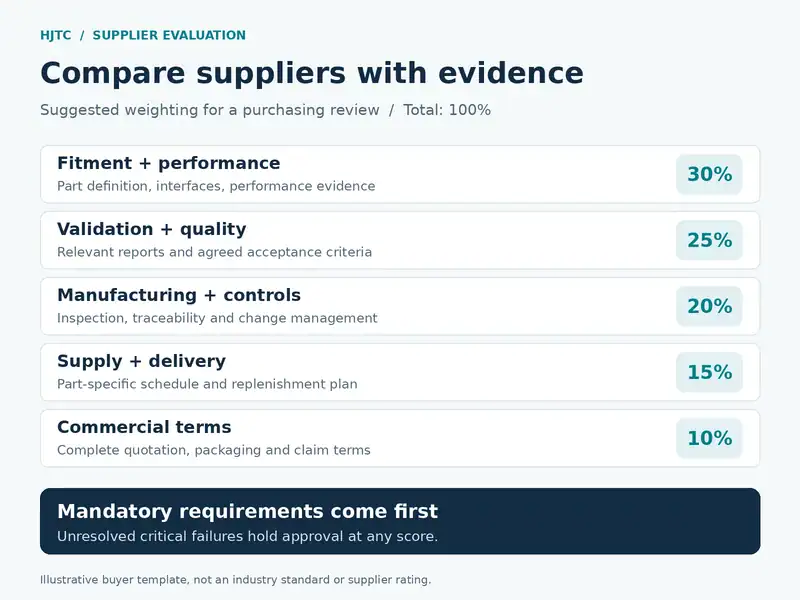
An illustrative purchasing scorecard; agree mandatory acceptance criteria first.
Prepare a Radiator RFQ That Suppliers Can Answer
Your request for quotation should allow suppliers to identify the part, assess the work and separate confirmed requirements from assumptions. Use this checklist for the first enquiry.
| RFQ field | What to include |
|---|---|
| Project and application | Replacement, new design or range expansion; vehicle or equipment; intended market |
| Reference information | OE references where applicable, supplier references being replaced, drawing revision or sample availability |
| Assembly definition | Core and overall dimensions, mountings, hose ports, auxiliary connections and included accessories |
| Operating requirements | Required duty, coolant, temperatures, flow and pressure limits, where available or needed for design |
| Approval requirements | Sample checks, performance and durability criteria, documents and customer-specific requirements |
| Demand | Sample quantity, first order, annual estimate, order mix and expected replenishment pattern |
| Delivery and packaging | Delivery destination, requested dates, packaging, labelling and delivery basis |
| Open items | Missing inputs, proposed assumptions and the person responsible for resolving them |
For an established aftermarket reference, begin with accurate application data and the required quantity. For custom development, provide the controlled drawing and known operating conditions.
Invite suppliers to list deviations and questions in their response. Before comparing quotes, circulate the same resolved requirements to all shortlisted bidders. This reduces differences caused by incomplete briefs.
Move from Sample Approval to Repeat Orders
Plan approval around recorded decisions:
- Review the proposal. Resolve assumptions, interfaces, scope and acceptance criteria.
- Inspect the sample. Check the agreed drawing, assembly details and relevant installation requirements.
- Complete validation. Review the required performance and durability evidence for the approved configuration.
- Release the initial order. Confirm production, inspection, packaging and shipment requirements.
- Review repeat supply. Track delivery, acceptance results, claims and approved changes.
Record outstanding actions before moving to the next stage. For an existing approved reference, the review can focus on the evidence and changes relevant to that purchase. A new design will usually need a broader approval plan.
The purpose is to carry the approved definition into every subsequent order, with a clear route for resolving any deviation.
Discuss Your Automotive Radiator Requirements with HJTC
HJTC’s automotive radiator range includes aluminium and copper-brass product options for passenger vehicles, commercial vehicles and off-highway applications.
To discuss a requirement, share the vehicle application or drawing, reference number where available, sample needs and expected order quantity. For custom projects, include the installation envelope and known operating conditions so that the technical requirements can be reviewed.
Confirm the proposed construction, available documentation, sample plan and delivery terms for the specific quotation. Where your project includes additional heat exchangers, identify each component and its duty separately in the enquiry.
Request a Radiator Quote / Submit Your Drawing
Frequently Asked Questions
How do I compare automotive radiator suppliers fairly?
Give each supplier the same part definition, demand forecast and approval requirements. Compare the evidence, scope and delivery terms using a common checklist. Resolve exclusions before scoring the offers.
What is the difference between OEM and aftermarket radiator sourcing?
A new OEM programme typically starts with design and programme requirements. Aftermarket sourcing often starts with an existing vehicle application and replacement reference. Both need a clear specification and an appropriate approval process; the label alone does not establish suitability.
Is IATF 16949 certification enough to approve a supplier?
Certification supports assessment of the relevant quality management system. You still need to confirm the site and scope, then review the part-specific evidence required by your programme.
Does a thicker radiator core always provide better cooling?
Core thickness alone is insufficient for selection. Compare assemblies using the same coolant and air conditions, with the available installation space and flow restrictions included in the review.
What information should I send for an existing replacement part?
Provide the complete reference number, vehicle details, engine, transmission, production period, destination market and quantity. Add photographs or dimensions when identification is uncertain.
How should I ask about MOQ and lead time?
Request MOQ per reference, mixed-order rules, sample timing, initial-order timing and repeat-order timing. Ask suppliers to identify the approvals, tooling or material assumptions behind each commitment.