

If you’ve ever watched a temperature gauge climb into the red on a hot afternoon, you already know the radiator isn’t just another part under the hood — it’s the single component standing between your engine and catastrophic failure. Industry data shows that an engine running just 20–30°F above its designed operating temperature can lose up to half of its expected service life, and prolonged overheating remains one of the top three causes of total engine replacement.
In nearly two decades of designing and manufacturing heat exchangers for passenger cars, commercial vehicles, and new-energy platforms, we’ve seen the same failure patterns repeat again and again — most of them entirely preventable. In the sections ahead, you’ll learn what a radiator actually does, how it transfers heat, why it fails, and how to extend its service life by years rather than months.
What Is a Radiator in a Car?

Definition and Core Function
A car radiator is a liquid-to-air heat exchanger whose single job is to pull heat out of your engine coolant and release it into the surrounding air. As coolant absorbs combustion heat from inside the engine block, it flows into the radiator’s network of thin tubes and fins, where moving air — both from your vehicle’s forward motion and from the cooling fan — carries that heat away.
Without this continuous heat-shedding cycle, your engine would reach destructive temperatures within minutes of starting. In simple terms: the radiator is what allows your engine to keep burning fuel without burning itself out.
Where It Fits in the Cooling System
The radiator is one node in a closed-loop cooling circuit that also includes the water pump, thermostat, cooling fan, expansion tank, hoses, and coolant itself. The water pump pushes coolant through the engine, the thermostat regulates when that coolant is allowed to flow into the radiator, and the radiator then transfers the absorbed heat to the air before the cycle repeats.
Think of it as your engine’s circulatory system — the water pump is the heart, the coolant is the blood, and the radiator is the lungs.
Radiator vs. Other Heat Exchangers (Condenser / Intercooler / Oil Cooler)
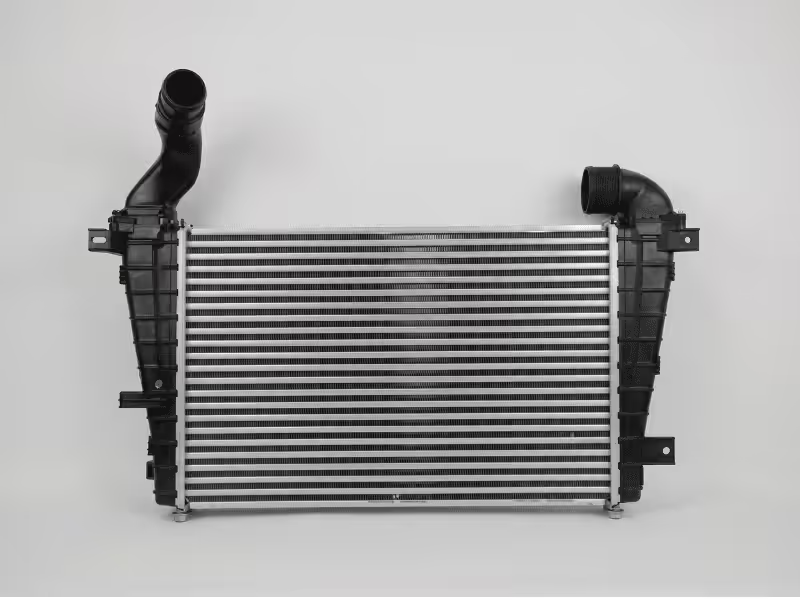
Modern vehicles actually carry multiple heat exchangers behind the front grille, and confusing them is one of the most common mistakes car owners make. With over 6,000 vehicle models on the road today — each with its own thermal architecture — manufacturers rely on several distinct units working in parallel:
| Component | Cools | Medium |
|---|---|---|
| Radiator | Engine coolant | Liquid → Air |
| Condenser | A/C refrigerant | Gas → Liquid |
| Intercooler (Charge Air Cooler) | Compressed intake air (turbo/supercharged engines) | Air → Air |
| Oil Cooler | Engine or transmission oil | Liquid → Air or Liquid → Liquid |
They may look similar from the outside, but each handles a different fluid, pressure range, and temperature window. Mistaking a condenser leak for a radiator leak, for example, is a costly diagnostic error we see in workshops every week.
How Does a Radiator Work? — The Thermodynamics Behind the Cooling Cycle
A radiator may look like a simple metal box with fins, but what happens inside it is a precisely engineered thermodynamic process. To understand why some radiators outperform others — and why some fail prematurely — you need to look at four interconnected mechanisms working in real time.
The Coolant Flow Path
When your engine starts cold, coolant stays trapped inside the engine block so it can warm up quickly. Once the thermostat senses the coolant has reached roughly 180–195°F (82–90°C), it opens and allows hot coolant to flow into the radiator’s upper tank. From there, the fluid travels downward (or sideways, in crossflow designs) through dozens of narrow tubes, gives up its heat, and exits through the lower tank back into the engine.
This loop repeats several times per minute at highway speeds — meaning your radiator is processing the engine’s entire coolant volume continuously, not in batches.
Heat Transfer Principles (Conduction → Convection)
Inside the radiator, heat moves in two stages. First, conduction transfers thermal energy from the hot coolant, through the tube walls, and into the attached aluminum fins. Then convection takes over: passing air sweeps across those fins and carries the heat away into the atmosphere.
The efficiency of this two-stage transfer depends on tube geometry, fin density, material conductivity, and coolant flow velocity — all of which interact in non-obvious ways. In modern radiator engineering, performance isn’t guessed — it’s simulated across three independent dimensions (thermal dissipation, pressure drop, and temperature distribution) before any tooling is cut. That’s why two radiators with identical outer dimensions can deliver very different real-world cooling capacity.
The Role of Airflow and Fan Assistance
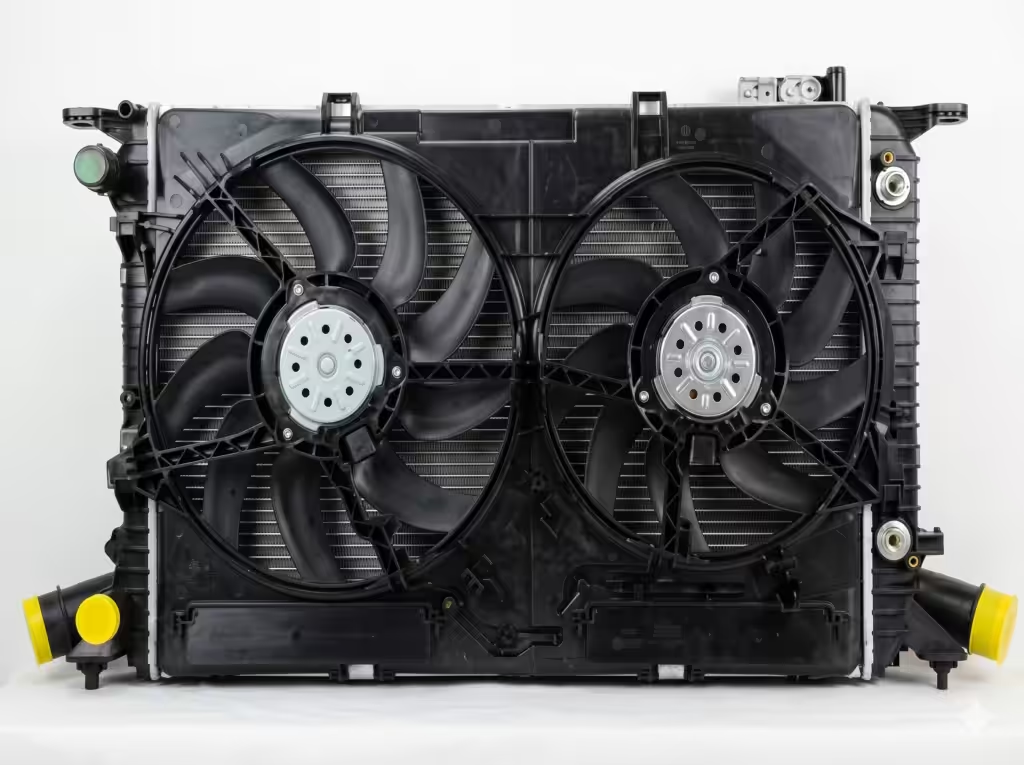
At highway speeds, ram air through the front grille provides most of the cooling airflow naturally. But in stop-and-go traffic, idling, or low-speed climbs, that natural airflow collapses — and this is where the cooling fan takes over.
Modern vehicles use either electric fans (triggered by coolant temperature sensors) or engine-driven viscous-clutch fans. When you hear your fan suddenly roar to life after parking, that’s the cooling system compensating for the loss of ram air to prevent heat soak.
Pressure Management and Boiling Point Elevation
Here’s a detail most drivers never learn: a radiator cooling system is pressurized on purpose. The radiator pressure cap typically holds the system at 13–16 PSI, which raises the coolant’s boiling point from 212°F (100°C) to roughly 257–265°F (125–129°C).
This pressure buffer is what prevents vapor lock and localized boiling at hot spots near the cylinder head. When a pressure cap fails — even slightly — the entire safety margin collapses, and the engine can overheat at temperatures that would normally be perfectly safe.
Components of a Radiator — Anatomy of a Heat Exchanger
A modern car radiator looks deceptively simple from the outside, but it’s actually an assembly of six precision-engineered components, each playing a distinct role in heat dissipation and long-term durability. Understanding what’s inside will also explain why two radiators with identical dimensions can have wildly different service lives.

Core (Tubes + Fins)
The core is the working heart of the radiator — a dense matrix of flat aluminum tubes carrying coolant, sandwiched by corrugated fins that multiply the heat-dissipating surface area. Tube width, fin pitch (typically 8–14 fins per inch), and louver geometry directly determine how much heat the core can shed per second. A well-designed core can expose over 2 square meters of effective cooling surface in a package no larger than a briefcase.
Tanks (Plastic vs. Aluminum)
Tanks sit at the top and bottom (or left and right) of the core, collecting and distributing coolant. Reinforced nylon (PA66-GF30) plastic tanks are lightweight and cost-effective, dominating passenger-car applications. All-aluminum tanks, joined to the core by welding rather than crimping, are preferred for heavy-duty trucks, performance vehicles, and commercial fleets where thermal cycling and vibration are extreme.
Inlet / Outlet Necks
These are the connection points where the upper and lower radiator hoses attach. They appear minor but are a frequent failure point — stress from hose clamps, vibration, and thermal expansion concentrates here. Quality units use reinforced neck geometry and, in aluminum designs, often integrate the neck via friction stir welding (FSW) or laser welding to eliminate porosity-related leaks.
Pressure Cap
As covered in Section 3, the pressure cap maintains 13–16 PSI inside the system to elevate the coolant’s boiling point. It also contains a vacuum relief valve that lets coolant flow back from the overflow tank as the system cools. A weak cap spring — often invisible to the naked eye — is one of the most under-diagnosed causes of overheating.
Drain Petcock
The petcock is a small valve at the bottom of the radiator that allows coolant to be drained during flushes and replacement. It’s a maintenance component, but a corroded or stripped petcock can turn a 20-minute coolant change into a half-day repair.
Manufacturing Processes Behind These Components
This is where most articles stop — but it’s also where radiator quality is truly decided. In factory-grade production, the bond between tube and fin is formed under controlled atmosphere brazing — typically nitrogen-protected at temperatures tightly held within process windows. This is what separates a 10-year radiator from a 3-year one.
Three manufacturing realities shape the radiator on your vehicle:
- Controlled-atmosphere brazing (CAB) in nitrogen-protected continuous tunnel furnaces creates a metallurgical bond — not a mechanical contact — between every tube and fin intersection. A poor braze joint means hot spots, premature cracking, and coolant seepage years before the rest of the radiator fails.
- Friction stir welding and laser welding are used at end-cap and tank-to-core interfaces in premium aluminum radiators, producing seams with near-parent-metal strength and virtually zero porosity.
- External anti-corrosion coatings, typically applied at a controlled thickness of 40–120 microns, protect the core from road salt, humidity, and stone impact. Too thin and corrosion penetrates within 2–3 years; too thick and heat transfer suffers measurably.
These aren’t optional refinements — they’re the difference between a radiator that lasts the life of the vehicle and one that fails just outside warranty.
Common Causes of Radiator Failure
Radiators don’t usually fail overnight. In most cases, they degrade silently for months — sometimes years — before a visible symptom appears. Understanding the five root causes below will help you spot trouble early and, just as importantly, recognize when a “cheap replacement” is setting you up for a repeat failure.
Internal Corrosion and Coolant Degradation
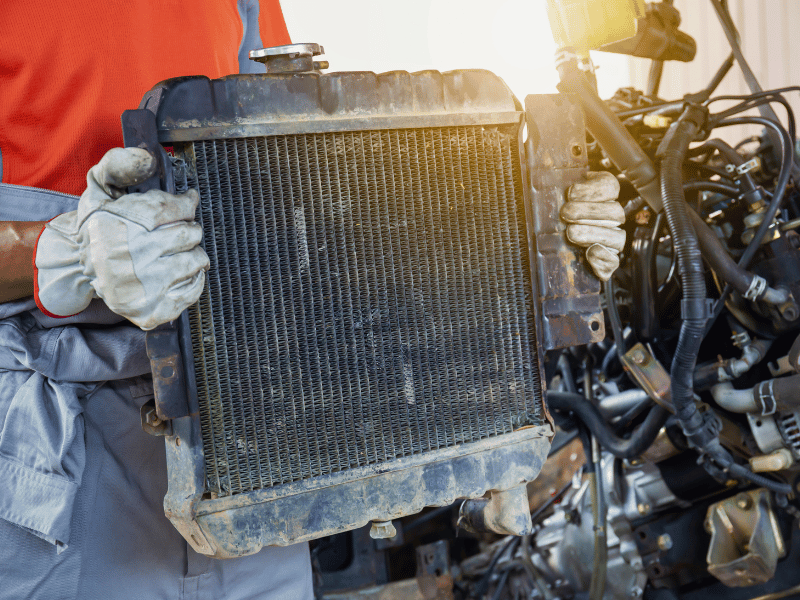
Coolant doesn’t just transfer heat — it also chemically protects the aluminum and copper alloys inside your radiator. Over time, the corrosion inhibitors in the coolant deplete (typically after 3–5 years or 60,000–100,000 km), and the fluid becomes electrolytically active. The result: pinhole leaks, internal scaling, and reduced tube cross-section.
Modern factory leak testing uses helium detection sensitive to roughly 50 ppm — a threshold so low it can catch a leak years before it would ever become visible as a drip. If a radiator passes that test on day one but starts seeping at year three, the cause is almost always coolant chemistry, not manufacturing.
External Damage (Stone Impact / Vibration Cracks)
Because the radiator sits at the very front of the vehicle, it absorbs constant abuse: stone strikes from the road, bug debris, salt spray, and chassis vibration transmitted through the mounts. Bent fins reduce airflow locally; cracked tubes leak coolant directly. Off-road and commercial vehicles see this failure mode 3–5× more often than daily-driven passenger cars.
This is also why the 40–120 micron anti-corrosion coating discussed in Section 4 matters so much — it’s the first line of defense against the environment your radiator actually lives in.
Tube-to-Fin Joint Failure
Recall that in a properly manufactured radiator, the tube-to-fin connection is a brazed metallurgical bond, not a mechanical contact. When that bond is weak — due to inconsistent furnace temperature, contaminated flux, or poor atmosphere control — heat transfer drops locally, hot spots form, and the joint eventually cracks under thermal cycling.
Visually, the radiator may look perfect. Functionally, it’s losing 10–20% of its rated cooling capacity. This is the #1 hidden failure mode in low-cost aftermarket radiators.
Pressure Cycling Fatigue
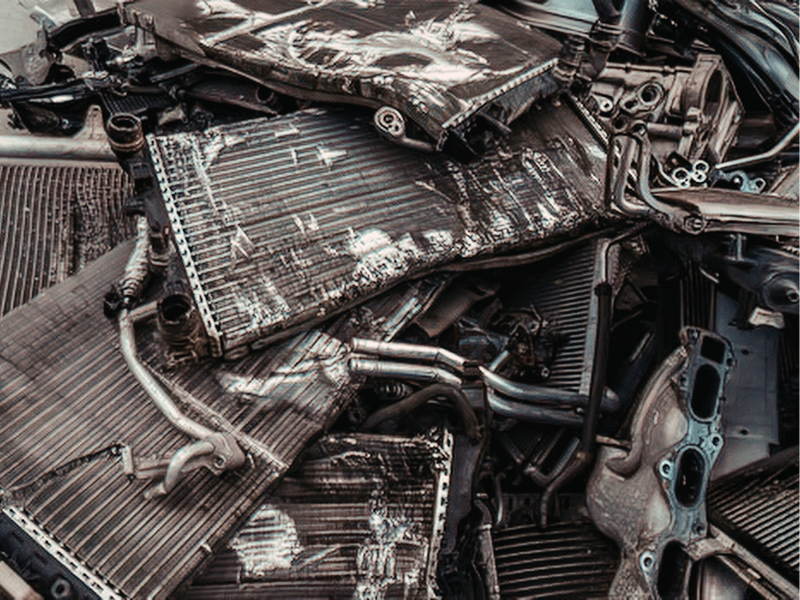
Every time your engine heats up and cools down, the radiator expands and contracts. At 13–16 PSI of internal pressure repeated thousands of times, even small stress concentrations — at neck welds, tank crimps, or solder joints — eventually fatigue and crack.
This is why a radiator can survive 8 years of highway commuting but fail within 18 months on a stop-and-go delivery route: it’s not total mileage that kills radiators, it’s thermal cycle count.
Manufacturing Defects vs. Operational Wear
Here’s the distinction most car owners never learn:
At the manufacturing level, every quality radiator passes through pressure cycling, vibration, salt spray, and thermal shock testing before shipment. The failures you see on the road are almost always failures these tests are specifically designed to catch.
In other words — if a radiator fails from vibration cracks, salt corrosion, pressure fatigue, or thermal shock, those are exactly the four conditions a factory-grade unit was validated against. A radiator that fails early hasn’t encountered “bad luck”; it’s encountered a stress mode its production line never tested for.
How to Tell If Your Radiator Is Failing — 7 Warning Signs
A failing radiator rarely gives you just one symptom — it gives you several, often subtle ones, weeks before a complete breakdown. Here are the seven warning signs every driver should recognize, ranked roughly from most common to most urgent.
1. Temperature gauge climbing into the red zone. The most obvious sign. If your gauge consistently runs hotter than normal — especially in stop-and-go traffic or while climbing — your radiator is no longer dissipating heat at its rated capacity. Urgency: high. Pull over before the needle peaks.
2. Coolant leaks under the vehicle. A bright green, orange, or pink puddle under the front of your car after parking is almost always coolant. Check the radiator core, hose connections, and lower tank seam. Urgency: medium-high. Small drips become major leaks fast.
3. Discolored or rusty coolant. Healthy coolant is translucent and brightly colored. If yours looks brown, milky, or has visible particles, internal corrosion is already advanced — and the corrosion inhibitors are exhausted. Urgency: medium. Flush and inspect within days.
4. Sweet smell from the engine bay. Ethylene glycol has a distinctive sweet odor. If you smell it after a drive — especially with no visible puddle — you likely have a slow leak evaporating off a hot surface. Urgency: medium. This is also a health hazard; coolant is toxic to pets.
5. Heater not blowing hot air. Your cabin heater relies on hot coolant flowing through the heater core. If the heater suddenly goes cold, coolant level may be low, or air may be trapped in the system from a leak. Urgency: medium. Often the first sign of a slow coolant loss.
6. Steam or vapor from under the hood. This means coolant is actively boiling or hitting hot engine surfaces. Urgency: critical. Stop driving immediately — continuing risks warped heads and a four-figure repair bill.
7. Visible fin damage or bent core. A quick visual inspection through the grille can reveal crushed fins, impact damage, or oily residue (a sign of transmission cooler failure in combo radiators). Urgency: low-to-medium, depending on extent.
Here’s the perspective that ties it all together: most radiator symptoms don’t appear overnight. They develop gradually — a slow seep becomes a steady drip, a faint sweet smell becomes visible steam, an occasional temperature spike becomes a roadside breakdown. The drivers who catch these signals in the first week pay for a $200 radiator service. The ones who wait three months pay for a$2,000+ engine repair. The radiator almost always warns you before it fails — the question is whether you’re listening.
Preventative Maintenance — How to Extend Radiator Life
A well-maintained radiator can outlast the vehicle it’s installed in. A neglected one rarely makes it to 100,000 km. The good news: radiator maintenance is among the simplest and cheapest preventative tasks on any vehicle. Here’s what actually matters.
Coolant Replacement Intervals
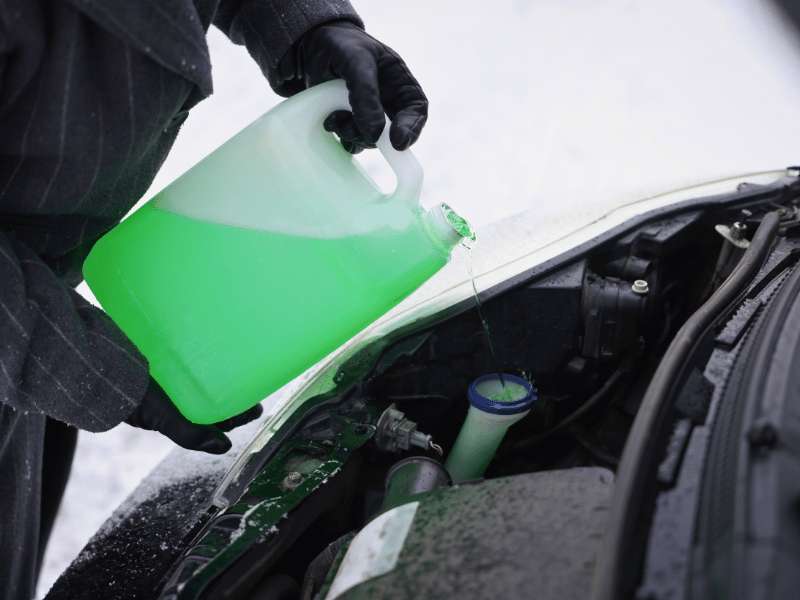
The single most important maintenance action is replacing the coolant on schedule — typically every 3–5 years or 60,000–100,000 km, depending on the coolant chemistry and manufacturer specification. Old coolant doesn’t just lose heat-transfer performance; its corrosion inhibitors deplete, and the fluid becomes electrolytically aggressive toward the aluminum core.
Worth noting: modern radiators benefit from significant material and structural advances over the past decade, with thermal management efficiency improving by roughly 25–30% in current-generation designs. This is why service intervals on newer vehicles are often longer than what you remember from older cars — the engineering has genuinely progressed.
Coolant Type Selection
Not all coolants are interchangeable. OAT, HOAT, and IAT formulations have different additive packages, and mixing them can cause gel formation, scaling, and accelerated corrosion. Always match the coolant to your manufacturer’s specification — not just by color, but by chemistry.
This matters more than most owners realize because OEM-grade radiators are co-developed with vehicle manufacturers, with materials, flow geometry, and coating chemistry tuned to a specific coolant standard. Using the wrong fluid breaks that match and shortens radiator life measurably.
External Cleaning and Fin Care
Over time, bugs, leaves, road salt, and debris accumulate between the radiator fins, choking airflow and reducing cooling efficiency by 10–20%. A gentle rinse with low-pressure water from the engine side outward (not high-pressure, which bends fins) every 6–12 months keeps the core breathing properly.
If fins are bent, a fin comb can straighten them — but work slowly. Aggressive combing causes more damage than it repairs.
Pressure Cap Inspection
Don’t overlook the pressure cap. It’s a $15 component, but a weak cap is one of the most underestimated causes of radiator and engine damage. When the cap can no longer hold its rated 13–16 PSI, coolant boils prematurely, internal pressure cycles intensify, and seals degrade from the inside long before any visible leak appears.
Have the cap pressure-tested every 2 years or at each coolant service — it takes under a minute at any qualified shop. A $15 test can prevent a $400 radiator replacement and, in worst cases, a $2,000+ engine repair.
Replace the cap whenever you replace the coolant. It’s the cheapest insurance policy in your engine bay.
When to Flush vs. When to Replace
A flush removes old coolant, scale, and debris from the cooling system — appropriate when coolant looks dirty but the radiator is structurally sound. A replacement is required when you see external corrosion, repeated leaks, bent or damaged tubes, or persistent overheating after flushing.
The general rule: if the radiator is over 8 years old and showing any symptoms from Section 6, replacement is almost always more economical than repeated repairs.
How Modern Radiators Are Engineered — Inside the Factory Floor
Up to this point, we’ve discussed how radiators work, fail, and should be maintained. But to understand why some radiators last 15 years and others fail in 18 months, you need to look inside the factory. The difference between a premium OEM-grade radiator and a low-cost aftermarket unit is rarely visible from the outside — it lies in the engineering discipline behind every step of production.©
From CAD to Coolant — The APQP Development Flow

Quality radiators don’t start at the assembly line; they start 12–18 months earlier in a 5-phase APQP (Advanced Product Quality Planning) development cycle: planning, product design, process design, validation, and feedback. Each phase has gated deliverables — including DFMEA (Design FMEA), PFMEA (Process FMEA), and control plans — that document every potential failure mode and its mitigation.
This is the structural difference between OEM-grade and “good enough” manufacturing. APQP is what allows a factory to guarantee consistency across 100,000 units, not just produce a single good prototype.
Brazing: The Process That Defines Radiator Lifespan
If one process determines whether a radiator lasts 5 years or 15, it’s brazing. Modern OEM-grade production uses two complementary furnace technologies: vacuum brazing and nitrogen-protected atmosphere brazing, each tuned to specific material combinations and core geometries.
Both processes require tight control of temperature ramps (typically ±3°C across the brazing window), flux distribution, and atmospheric purity. When done correctly, every tube-to-fin joint becomes a continuous metallurgical bond — not a mechanical contact. When done poorly, those same joints become the failure points discussed in Section 5.3.
100% Leak Detection — Why Helium Testing Matters

Every quality radiator undergoes 100% leak inspection before shipment — not statistical sampling. The most sensitive method, helium mass spectrometry, can detect leaks down to roughly 50 ppm — a threshold thousands of times tighter than what a customer could ever observe in service.
Why does this matter? Because leaks that are invisible at the factory will become visible to the driver — but only after months of pressure cycling. A 50 ppm leak today is a roadside breakdown in year three. This is why “100% tested” on a spec sheet is not marketing language; it’s a structural commitment to long-term reliability.
Surface Protection: The 40–120μm Coating Standard
Once assembled and tested, OEM-grade radiators receive a controlled anti-corrosion surface treatment — typically 40 to 120 microns thick, depending on the operating environment. Coastal, off-road, and commercial-vehicle radiators sit at the higher end of that range; passenger-car applications at the lower end.
This isn’t cosmetic. Salt spray testing (ASTM B117) data consistently shows that radiators below the 40-micron threshold begin showing surface corrosion within 240–500 hours of accelerated exposure — equivalent to 2–4 years in real-world coastal climates.
Why Not All Aftermarket Radiators Are Equal
Here’s the perspective worth taking home:
A radiator may look like a simple bolt-on part, but behind every OEM-grade unit lies a 5-phase APQP development cycle, controlled- atmosphere brazing within tight process windows, helium leak detection down to 50 ppm, and a 10-test validation matrix covering pressure cycling, salt spray, vibration, and thermal shock. The real difference between a $40 aftermarket radiator and a $200 OEM-equivalent isn’t the metal — it’s everything that happens to that metal before it leaves the factory.
Factories operating at this standard typically run 5 flexible assembly lines producing 2,000+ units per day, with traceability documented from raw material to shipment. That’s not a feature — it’s the minimum entry ticket for OEM supply.
Summary — Key Takeaways
The radiator is one of the most underrated components in any vehicle — quiet, unglamorous, and absolutely critical. If you remember only a few things from this guide, make them these:
- A radiator manages heat, not just coolant. Its job is to keep the engine inside a narrow thermal window where everything else works correctly.
- Material and structure matter more than appearance. Aluminum-plastic, full-aluminum, and copper-brass designs each suit different use cases — choose by application, not by price tag.
- Most failures are preventable. Coolant neglect, wrong fluid chemistry, and overlooked pressure caps cause more radiator deaths than manufacturing defects ever will.
- Symptoms compound quickly. A sweet smell today is a warped cylinder head tomorrow — act on the seven warning signs early.
- Manufacturing discipline is invisible but decisive. APQP, controlled-atmosphere brazing, 100% leak testing, and certified coatings are what separate a 15-year radiator from an 18-month one.
Behind every reliable radiator is decades of engineering iteration. The most experienced manufacturers in this field carry 18+ years of production know-how and have developed 6,000+ vehicle-specific models — a depth of application data that simply cannot be shortcut.
If you are evaluating radiator selection, sourcing standards, or quality benchmarks for your project, feel free to reach out to our engineering team — we’re always happy to talk shop.
Frequently Asked Questions
Q1. How long does a car radiator last on average?
A well-maintained OEM-grade radiator typically lasts 8–15 years, or roughly 150,000–250,000 km. Lifespan depends heavily on coolant maintenance, operating environment, and manufacturing quality. Radiators in coastal or stop-and-go conditions tend toward the lower end; those in moderate climates with regular coolant service often exceed 15 years.
Q2. Can I drive with a leaking radiator?
No — avoid it whenever possible. A leak means coolant is dropping, and even brief overheating can warp the cylinder head or crack the engine block, turning a $200 radiator repair into a $3,000+ engine job.
If you must reach a service shop: top up coolant, keep it under 10 minutes, and stop immediately if the gauge climbs toward red. Otherwise, call a tow — $100–200 beats a $3,000+ rebuild every time.
Q3. Aluminum vs. copper-brass radiator — which is better?
Neither is universally better — they serve different applications. Aluminum-plastic radiators are lighter and dominate modern passenger cars. Copper-brass radiators offer higher thermal conductivity and field repairability, making them preferred for heavy trucks, construction equipment, and vintage restorations. Choose by application, not by assumption.
Q4. How is a radiator different from a condenser?
The radiator cools engine coolant; the condenser cools refrigerant in the air conditioning system. They look similar and sit next to each other in front of the vehicle, but they serve completely separate thermal circuits. Replacing one does not address problems in the other.
Q5. What’s the difference between OEM and aftermarket radiators?
OEM-grade radiators are built to the original vehicle manufacturer’s specifications — same materials, same flow geometry, same testing standards. Aftermarket radiators vary enormously in quality, from near-OEM equivalents to budget units that compromise on tube thickness, brazing quality, or surface protection. Price alone is not a reliable indicator.
Q6. How can I tell if a replacement radiator is good quality?
Look for four signals: (1) APQP-based development with documented design and process controls, (2) 100% leak testing — preferably helium-based, sensitive to ~50 ppm, (3) certified coating thickness in the 40–120μm range, and (4) a published multi-test validation matrix covering pressure, vibration, salt spray, and thermal shock. Anything less is a gamble.