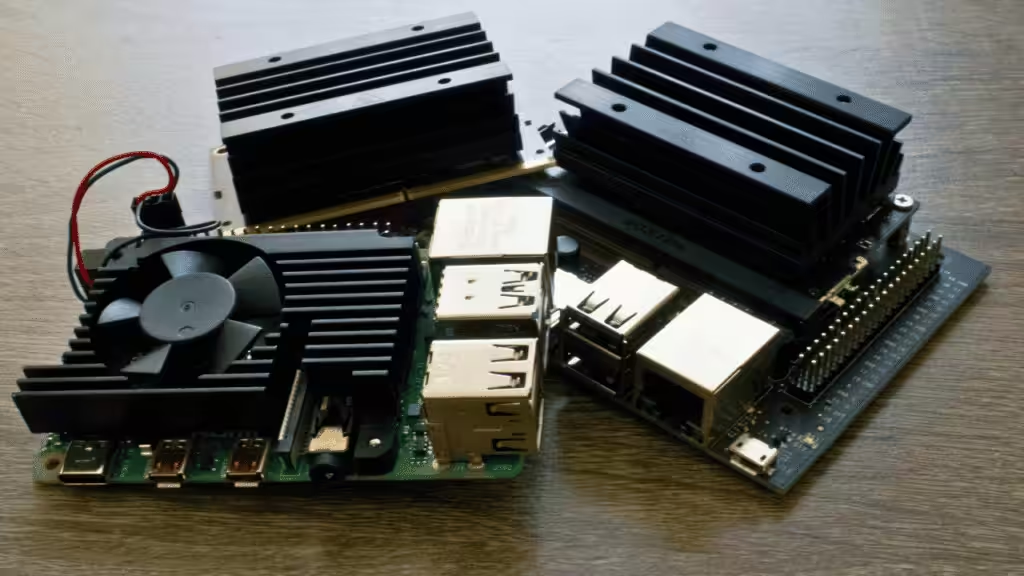
Pushing past 400W TDPs and 50 W/cm² heat fluxes? Standard extruded heat sinks may have just hit their ceiling — and skived fins are likely on your shortlist.
In our factory, extruded and skived production lines run side by side. Over 14 years, that’s given us a rare, unbiased view of when each process actually wins — backed by hundreds of dual-process feasibility studies for clients in AI servers, EV power, and 5G.
Below, we’ll break down the real performance, cost, and yield differences between skived and extruded heat sinks — including the trade-offs single-process suppliers usually skip.
Let’s get into it.
What Is a Heat Sink?
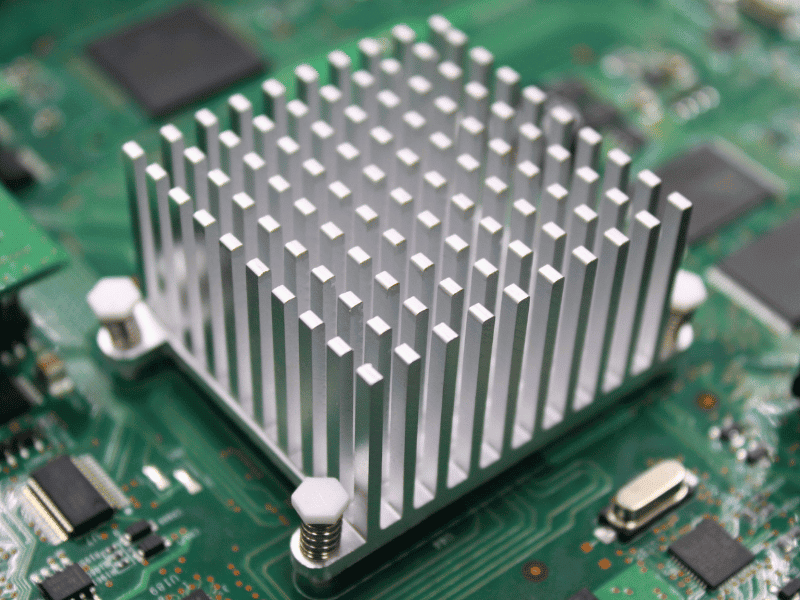
A heat sink is a passive component that pulls heat away from an electronic device — a CPU, an IGBT, an LED — and dumps it into the surrounding air. Simple in concept, but the details are where designs live or die. (If you want the full fundamentals — materials, types, working principle — see our complete guide to heat sinks.)
The key concept most datasheets gloss over is the thermal resistance chain. Heat doesn’t just “leave” a chip — it has to travel through a series of resistances:
Junction → TIM → Heat sink base → Fins → Air
Each link in that chain adds resistance (°C/W). Your total cooling performance is only as good as the weakest link. And in most modern high-power designs, the weakest link is almost always the fin-to-air interface — which is exactly where skived and extruded processes part ways.
Why Fin Density Matters More Than You Think
Fin design controls two things: surface area and airflow access. Pack more fins into the same footprint and you increase surface area — but only up to a point. Squeeze them too close, and airflow stalls.
The relationship is non-linear: halving the fin pitch doesn’t double your performance, but in the right airflow window, it gets close.
From our test bench: On the same 100×100mm base, tightening fin pitch from 4mm to 2mm dropped thermal resistance by 25–35% — but only when paired with at least 2 m/s of forced airflow. Without that airflow, the dense fins choked and performance actually got worse. This airflow-vs-density trade-off is the entire reason skived heat sinks exist.
Skived Heat Sinks: Everything to Know
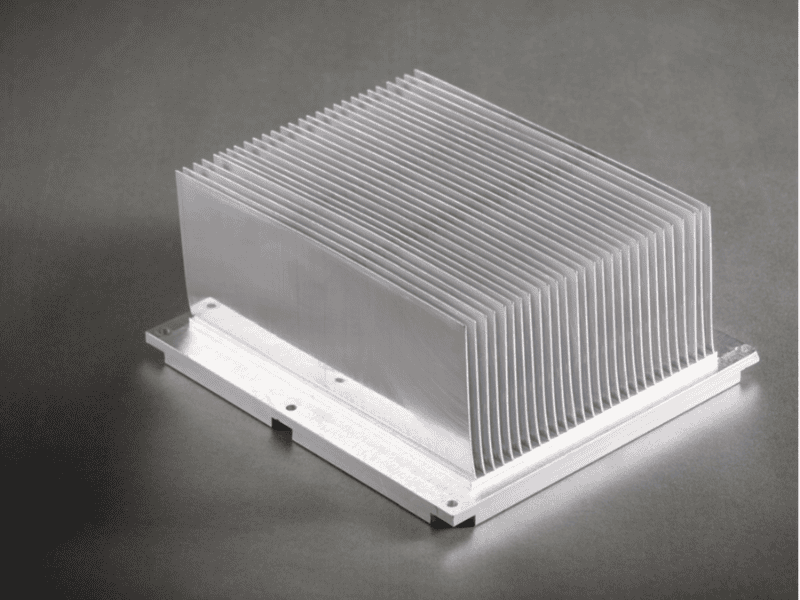
If extruded heat sinks are the workhorse of thermal management, skived heat sinks are the specialist — built for situations where extrusion simply can’t deliver enough fin surface area in a confined space. Understanding how they’re made explains why they perform the way they do, and why they cost what they cost.
What Makes Skived Heat Sinks Different
A skived heat sink is machined from a single solid block of copper or aluminum. Instead of pushing metal through a die (extrusion) or assembling separate fins (bonded), a precision blade slices thin layers off the block and lifts them upright — one fin at a time — while keeping each fin monolithically connected to the base.
The result is a heat sink with no joints, no thermal interface, and no assembly tolerances between the fins and the base. The fins are the base. That single structural fact drives every performance advantage skived heat sinks offer.
Manufacturing Process
Skiving looks deceptively simple on paper, but each step hides a precision requirement that determines final performance:
Step 1 — Billet Preparation: A solid block of copper (C1100, ~400 W/m·K) or aluminum (typically 1050/6063) is prepared to exact dimensions. Copper is where skiving truly shines — and notably, copper skived heat sinks are something extrusion simply cannot produce at scale, because copper’s mechanical properties make conventional extrusion impractical.
Step 2 — Precision Skiving: A high-precision blade enters the billet at a controlled angle and continuously “shaves” thin layers of metal. Cutting depth, angle, and feed rate are tuned to the material — copper requires different parameters than aluminum.
Step 3 — Fin Formation: As each layer is shaved, the blade lifts the slice upright to form a fin — but critically, the fin remains integral to the base material. There is no joining, no soldering, no epoxy. The thermal path from base to fin is uninterrupted metal.
Step 4 — Finishing: The completed block is cut to length, deburred, and surface-treated (anodizing for aluminum, nickel plating or anti-oxidation coating for copper).
From our skived production line: The core challenge of skiving isn’t the equipment — it’s tool life management. A high-precision skiving blade machining copper typically needs regrinding every 800–1,200 parts. This directly drives production cadence and cost structure, and it’s the fundamental reason skived heat sinks carry a significantly higher unit price than extruded ones. Anyone quoting you “cheap skived heat sinks” likely isn’t using the tooling discipline that performance-grade skiving requires.
Thermal Advantages
This is where skived heat sinks earn their premium:
✅ Extreme fin aspect ratio — Skiving achieves fin height-to-thickness ratios of 40:1, even 60:1, compared to extrusion’s practical ceiling of around 12:1. Translation: 3–5× more surface area in the same footprint.
✅ Zero base-to-fin interface resistance — Because fins and base are one continuous piece of metal, there is no thermal boundary, no TIM, no bond layer. Heat flows from base to fin tip with nothing in the way.
✅ Copper compatibility — Skiving works beautifully with pure copper (~400 W/m·K), nearly doubling the thermal conductivity of aluminum 6063 (~200 W/m·K). For high-power-density applications, this alone can justify the cost.
✅ High-density, small-footprint cooling — When you need to dissipate 200W+ from a 50×50mm chip with limited vertical space, skived copper is often the only passive solution that works without active cooling escalation.
Considerations and Limitations
Skived isn’t a silver bullet. Real engineering tradeoffs apply:
❌ Higher unit cost — Tooling wear, slower cycle times, and more demanding QC push skived prices 2–4× higher than equivalent extruded parts. For low-power applications, you’re paying for performance you don’t need.
❌ Mechanical fragility — Thin, tall fins are vulnerable to bending during handling, shipping, and assembly. Protective packaging and careful PCB integration are non-negotiable.
❌ Geometric limitations — Skiving produces parallel straight fins only. If your design needs pin-fins, radial fins, or complex 3D geometry, skiving is the wrong process — you’ll need forged, bonded, or CNC-machined alternatives.
❌ Longer lead times — Tool preparation, slower machining, and finishing operations typically push lead times to 3–5 weeks, versus 1–2 weeks for standard extrusion.
Extruded Heat Sinks: A Quick Introduction
Since we’ve covered extruded heat sinks in depth previously, this section focuses on the comparison anchors you need to weigh skived against — not a full re-explanation. If you want the complete picture, the linked guide below covers it end-to-end.
Manufacturing Process (In Brief)

Extrusion is conceptually straightforward: an aluminum billet (typically 6063-T5) is heated to around 450–500°C and forced under high pressure through a steel die that defines the heat sink’s cross-section. The extruded profile is then cut to length, optionally CNC-machined for mounting features, and surface-treated (anodizing being most common).
The entire cross-section — base and fins — emerges as one continuous piece in a single pass. That’s the source of both extrusion’s strengths and its constraints.
👉 For a detailed breakdown of the extrusion process, materials, and design parameters, see our complete Extruded Heat Sink Guide.
Design Flexibility
Extrusion’s biggest advantage isn’t thermal — it’s geometric freedom in the cross-section. Because the die defines the shape, designers can specify:
- Variable fin thicknesses across the profile
- Integrated mounting channels, T-slots, or screw bosses
- Asymmetric layouts tailored to specific PCB footprints
- Wider base sections combined with fin arrays in a single profile
And once the die exists, per-unit tooling cost approaches zero. That’s why extrusion dominates high-volume, cost-sensitive markets — power supplies, LED lighting, consumer electronics, automotive electronics.
Limitations and Considerations
Where extrusion hits a wall:
❌ Fin aspect ratio capped near 12:1 — Push beyond this and fins tear, warp, or fail to fill the die properly. This is the hard physical ceiling that creates the entire reason for skiving to exist.
❌ Copper is impractical at scale — Copper’s flow behavior under extrusion pressure is fundamentally different from aluminum’s, and the tool wear is prohibitive. Production-grade copper extruded heat sinks essentially don’t exist in commercial volumes.
❌ No complex 3D structures — Cross-section is constant along the extrusion axis. Pin-fin arrays, radial layouts, or variable-height fins along the length are impossible without secondary machining.
From our extrusion floor: A standard extruded heat sink die takes about 3–5 weeks to develop and delivers a working life of 8,000–15,000 meters of extruded length before requiring rework. On orders of 10,000+ units, the amortized tooling cost drops to just a few cents per part — a scale economy that skiving fundamentally cannot match. This is why the decision between skived and extruded almost always comes down to volume × performance requirement, not preference.
Skived vs Extruded: Performance Comparison

By now you understand how each process works. The real question is: which one belongs in your design? This section gives you the side-by-side data and the decision framework — based on numbers we’ve measured on our own benches, not catalog claims.
Head-to-Head Performance Table
| Performance Metric | Skived Heat Sink | Extruded Heat Sink |
|---|---|---|
| Fin Aspect Ratio | 40:1 – 60:1 | 8:1 – 12:1 |
| Min Fin Thickness | 0.3 mm | 1.0 mm |
| Min Fin Pitch | ~1.0 mm | ~2.5 mm |
| Material Options | Aluminum, Copper | Aluminum (primarily) |
| Thermal Resistance | Lower (denser fins) | Moderate |
| Base-to-Fin Interface | Seamless (one piece) | Seamless (one piece) |
| Heat Flux Capability | High (>50 W/cm²) | Moderate (10–30 W/cm²) |
| Typical Unit Cost | 2–4× extruded | Baseline |
| Typical Lead Time | 3–5 weeks | 1–2 weeks |
Two notes on this table worth highlighting:
First, both processes deliver a seamless base-to-fin interface — this is a common misconception. The thermal advantage of skiving isn’t whether the fin connects to the base, but how many fins you can pack in and what material you can use.
Second, the heat flux capability gap (>50 W/cm² vs 10–30 W/cm²) is where most designs are actually decided. Below 30 W/cm², extrusion almost always wins on total cost of ownership. Above 50 W/cm², extrusion physically cannot keep up.
When Skived Wins
Choose skived when your design hits any of these conditions:
✅ High power density — CPUs, GPUs, AI accelerators, IGBT modules, and 5G RRU equipment dissipating >100W from sub-50mm² die areas ✅ Tight vertical envelope — When you need maximum fin surface area within a constrained Z-height (1U server chassis, telecom enclosures) ✅ Copper is mandatory — Applications where ~400 W/m·K conductivity is non-negotiable (high-frequency power electronics, laser diodes) ✅ Low-to-mid volume — Below ~5,000 units, where extrusion’s tooling amortization advantage hasn’t kicked in yet
When Extruded Wins
Choose extruded when your design fits any of these patterns:
✅ Moderate thermal load — Heat flux below 30 W/cm² covers the vast majority of LED, power supply, and industrial control applications ✅ High volume — 10,000+ units per year, where amortized tooling cost makes extrusion 3–4× cheaper per piece ✅ Cost-sensitive markets — Consumer electronics, automotive aftermarket, commercial LED lighting ✅ Complex cross-section geometry — When you need integrated mounting features, T-slots, or asymmetric profiles that skiving structurally cannot produce
Real-world benchmark from our lab: On an identical 100×100×40mm envelope at 2 m/s forced airflow, a copper skived heat sink delivered 40–50% lower thermal resistance than an aluminum extruded equivalent — but at 3–4× the unit cost. That single trade-off captures the entire decision: are you paying for performance you actually need, or paying a premium for headroom your application will never use? Define your heat flux and your volume first. The right process answers itself.
Skived vs Extruded: Cost and Manufacturing Economics
Most thermal management articles stop at “skived is more expensive.” That’s not useful. What you actually need to know is why the cost gap exists, how it scales with volume, and at what point the economics flip. This section breaks down the numbers we work with every day on real customer quotes.
Tooling Cost Comparison
The starting point of every cost conversation is tooling — and the two processes have fundamentally different tooling economics:
| Item | Skived | Extruded |
|---|---|---|
| Upfront tooling cost | Moderate (precision blade set) | Higher (extrusion die) |
| Per-unit amortization | Higher, doesn’t scale down | Extremely low at volume |
| Rework / replacement | Blade regrinding (recurring) | Die touch-up or recut |
| Typical tooling lifespan | 800–1,200 parts per regrind | 8,000–15,000 meters of extrusion |
The critical insight: extruded tooling cost is a fixed investment that disappears into volume. Skived tooling cost is a recurring operational expense baked into every part you ship. No matter how many units you order, the blade still needs regrinding every ~1,000 parts. That’s why the skived unit price curve flattens out — it cannot collapse the way extrusion’s does.
Per-Unit Cost Breakdown
Where the money actually goes inside each part:
Skived heat sink cost structure:
- Material: ~25–30%
- Machining labor + tool wear: 60%+
- Finishing & QC: ~10–15%
Extruded heat sink cost structure:
- Material: 55–65%
- Extrusion processing: ~20–25%
- Finishing & QC: ~15–20%

This explains a counterintuitive truth: when aluminum prices spike, extruded heat sinks feel the pain immediately, while skived prices barely move. But when labor or precision tooling costs rise, skived gets squeezed first. The two processes have opposite sensitivities to input cost fluctuations — useful intelligence when you’re planning long-term supply contracts.
The Volume Crossover Point
At what order quantity does extrusion’s economics decisively beat skiving?
Empirically, the crossover begins around 2,000–5,000 units, and becomes overwhelming above 10,000 units.
From our cost engineering team: We recently ran a direct comparison for a telecom customer — identical specifications, same envelope, same thermal target. At 5,000 units, extruded came in at unit price X; skived quoted at 3.2X. When we re-priced the same parts at 50,000 units, extruded dropped to 0.7X, while skived only dropped to 2.8X. In other words, a 10× volume increase widened the cost gap from 3.2× to 4×, not narrowed it. This isn’t a negotiation outcome — it’s the mathematical signature of two fundamentally different cost structures.
The takeaway: if your annual volume is heading north of 10,000 units and your heat flux allows it, every additional unit you order makes extrusion look better, not worse. Conversely, for prototyping and sub-2,000 runs, the tooling amortization argument for extrusion collapses — and skived’s flexibility often wins outright.
Skived vs Extruded: Mechanical Strength and Handling
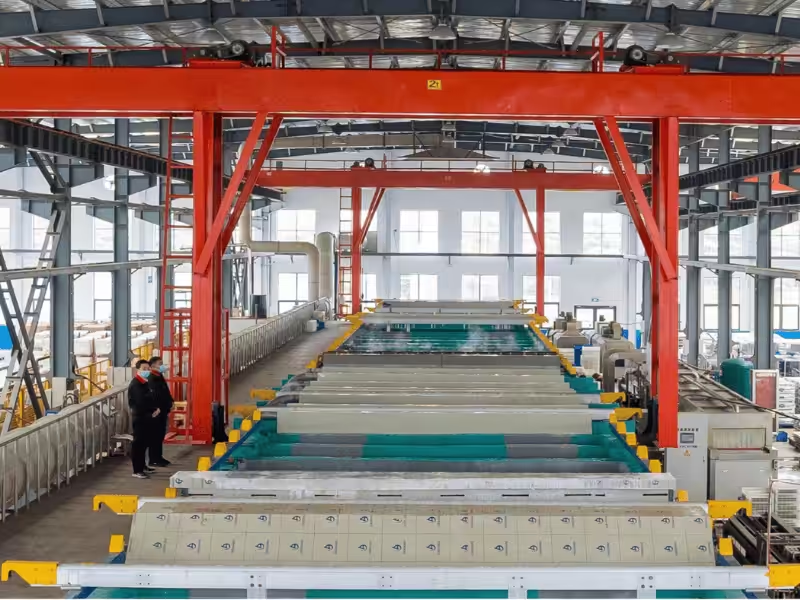
Thermal performance and cost get all the attention. But the heat sink that performs brilliantly in your CFD simulation still has to survive a shipping container, an assembly line, and ten years in the field. This is where the two processes diverge in ways most spec sheets never mention.
Fin Robustness
Extruded fins are typically 1.0 mm thick or more, with generous root fillets where they meet the base. They tolerate accidental contact, light tooling impacts, and rough handling during PCB assembly. A dropped extruded heat sink usually still meets spec.
Skived fins are a different story. At 0.3 mm thickness and 60:1 aspect ratios, they behave almost like metal foil. A fingernail dragged across the fin tips can deform them; a tool slipping during assembly can fold an entire row. The same geometry that delivers the thermal advantage is also a mechanical liability that has to be designed and packaged around.
Vibration and Shock Resistance
Operating environment matters more than most engineers expect:
- High-vibration applications (EV powertrains, off-highway equipment, industrial drives): Extruded wins. Thicker fins resist fatigue cracking at the base-to-fin junction under sustained vibration loads.
- Static or low-vibration environments (data center racks, telecom cabinets, lab instruments): Skived is fully reliable. With no mechanical excitation, the thin-fin geometry holds up indefinitely.
The rule of thumb we give customers: if the application sees more than 5G RMS sustained vibration, default to extruded unless thermal requirements force otherwise.
Assembly and Logistics Considerations
Skived heat sinks demand special handling protocols:
- Individual foam-insert packaging
- Protective fin guards during transit
- Slower, more careful pick-and-place during assembly
- Higher inspection rejection rates from minor handling damage
Extruded heat sinks can be bulk-palletized, stacked, and handled with standard logistics — meaningful when you’re shipping tens of thousands of units across continents.
From our packaging team: We package skived heat sinks with individual foam dividers and reinforced corner protection — adding roughly 15–20% to total packaging cost versus the bulk-palletized approach used for extruded parts. It’s the line item that disappears from initial quotes and reappears in the landed cost. Worth budgeting for from day one.
Surface Finishes & Thermal Coatings
Both skived and extruded heat sinks accept the standard family of industrial finishes — but the process you chose upstream dictates how cleanly those finishes apply downstream. This is one of the most overlooked manufacturability issues in thermal design, and it can quietly compromise both appearance and emissivity if handled poorly.
Finishes Compatible with Both Processes
Both processes routinely accept:
- Anodizing (clear, black, custom colors) — improves emissivity to ~0.85+ and adds corrosion protection
- Powder coating — durable cosmetic finish, customizable color, slightly insulating
- Electrophoretic (E-coating) — uniform thin-film coating, excellent corrosion resistance
- Chromate conversion / passivation — for solderable or grounded interfaces
For a full breakdown of finish selection by application, see our earlier guide on [aluminum heat sink surface treatments]. The differentiator worth focusing on here is how skived vs extruded geometries affect finish quality — which spec sheets almost never address.
Process-Specific Considerations
Skived heat sinks present three real challenges:
- Narrow fin gaps restrict fluid penetration. With fin pitch as tight as 1.0 mm, anodizing electrolyte and powder coating particles struggle to reach the fin roots, producing visible coating gradients between fin tips and base.
- High aspect ratio creates electrical field shadowing during anodizing, which can cause uneven oxide layer thickness — sometimes 10–15% thinner at the deep fin roots.
- Copper skived parts require oxidation barriers. Bare copper tarnishes within days; electroless nickel plating (3–8 μm) is the standard solution for shippable, long-life copper assemblies.
Extruded heat sinks have a structural advantage here:
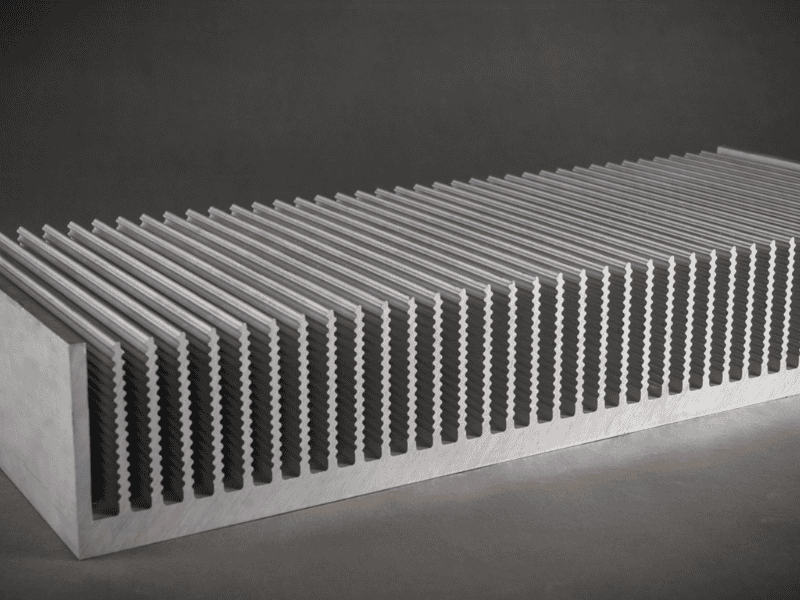
The open profile and 2.5 mm+ fin pitch let coating fluids circulate freely, producing highly uniform finishes with standard line equipment — no special tooling, no extended dwell times, no rejection rate penalty.
From our surface treatment line: On skived parts with fin pitch below 1.5 mm, standard anodizing uniformity drops by roughly 10–15% measured across fin height. To solve this, we run high-density skived parts through a dedicated immersion line with extended dwell time and agitation, which restores coating uniformity to within ±3% — but adds processing time and cost. If your skived design specifies sub-1.5mm pitch and a critical anodized finish, factor this into both lead time and quoting.
Skived Heat Sink vs Extruded Heat Sink: Which One Is Better?
There is no universal winner — and any supplier who tells you otherwise is selling, not engineering. After seven sections of technical comparison, here is the decision framework we actually use when a customer asks us to recommend a process.
Decision Framework — 4 Questions to Ask
Walk through these four questions in order. The answers will steer you toward the right process in under five minutes:
1. What is your thermal budget (°C/W)? → If your target is below 0.3 °C/W, skived is usually the only viable path. Above 0.5 °C/W, extruded almost always wins on cost.
2. What is your production volume? → Below 2,000 units/year, skived’s tooling flexibility wins. Above 5,000 units/year, extruded’s per-unit economics dominate. The 2,000–5,000 band is the genuine gray zone where total cost modeling is required.
3. Is your space envelope constrained? → If fin pitch must be below 1.5 mm or aspect ratio above 20:1, skived is the only manufacturable option. If you have room to spread out, extruded delivers equivalent thermal performance at lower cost.
4. Is the operating environment static or dynamic? → Sustained vibration above 5G RMS or aggressive thermal cycling pushes the decision toward extruded for long-term mechanical reliability.
Application-Based Recommendations
| Application | Recommended Process |
|---|---|
| CPU / GPU / AI server modules | Skived (copper) |
| 5G base station RRU/AAU | Extruded (most cases) |
| IGBT power modules | Depends on power density |
| EV motor controllers | Extruded |
| LED street lighting | Extruded |
| High-power industrial lasers | Skived |
| Telecom outdoor cabinets | Extruded |
| Lab / measurement instruments | Either — driven by cost |
The Hybrid Approach
For projects that don’t fit cleanly into either bucket, a third path exists: hybrid construction. Common configurations include:
- Extruded base + bonded skived fin array — combines extrusion’s cost-efficient base plate with skived’s high fin density where it matters
- Bonded-fin assemblies — discrete fins mechanically or epoxy-bonded into an extruded or machined base
- Friction Stir Welded (FSW) liquid-cold plate + skived fin top — for hybrid air/liquid cooling
Hybrid designs add complexity but can deliver 80% of skived performance at 50% of skived cost for the right application — provided your supplier runs both production lines under one roof. (We do.)
Real client case: A European variable-frequency drive manufacturer initially specified skived for a 15 kW controller. Our engineering team ran the thermal numbers and proposed an alternative: extruded with optimized fin geometry and upgraded TIM. The redesign passed full-load 70°C ambient testing and delivered a 38% lower unit price. We could have quoted the skived design and made a bigger margin — but recommending the right process, not the most expensive one, is how 10-year customer relationships actually get built.
Why Work with a Manufacturer That Offers Both Processes
This is the question that doesn’t appear on any thermal design checklist — but should. The supplier you choose shapes the recommendations you receive, and a supplier with only one production line has only one answer to give.
The Single-Process Supplier Problem

The thermal supply chain has a structural bias that most buyers underestimate:
- Suppliers that only operate skiving lines will frame skived as the modern, superior choice — even when extruded would meet the spec at half the cost.
- Suppliers that only operate extrusion lines will steer borderline projects toward extruded geometries — even when the thermal budget genuinely demands skived performance.
- Suppliers that outsource the process they don’t run in-house lose control of quality, lead time, and pricing — and that cost lands on your invoice.
The result: buyers rarely receive a process-neutral recommendation unless they actively shop the same RFQ across multiple supplier types. That’s a slow, expensive way to get to the right answer.
Our Dual-Capability Advantage
We’ve structured our factory to remove that bias from the conversation:
- ✅ Full in-house extrusion and skiving lines — no outsourcing, no markup, no quality handoffs
- ✅ Complementary processes under one roof: bonded-fin, heat pipe assembly, stamped, and CNC finishing
- ✅ Engineering team trained on both processes — recommendations are based on thermal simulation and total cost modeling, not on which line happens to be available
- ✅ 14+ years focused on power electronics thermal management — EV, 5G, AI server, industrial drive verticals
How Our Engineering Consultation Works

A typical dual-process evaluation runs like this:
- You submit application specs, thermal budget, envelope constraints, and volume forecast
- Our engineers run parallel evaluations — extruded scenario vs skived scenario, with CFD where geometry is non-trivial
- You receive a comparison report — thermal performance, unit cost at volume, tooling investment, lead time, and risk factors for both options
- You decide — with the data you need to defend the choice internally
Last year alone, our engineering team completed 170+ dual-process feasibility studies for clients — and in roughly 30% of those cases, we recommended a process different from what the client originally requested. Sometimes that meant talking a customer out of an expensive skived spec; sometimes it meant pushing back on an extruded design that wouldn’t hit the thermal target. That’s what having both lines under one roof actually buys you: the freedom to recommend the right answer, regardless of which production line gets the order.
Frequently Asked Questions
Q1: Can skived heat sinks be made from aluminum, or only copper?
Both materials work. Aluminum 1050 and 1100 are commonly skived for cost-sensitive applications, while copper C1100 is preferred when thermal conductivity is critical (e.g., CPU, GPU, high-power laser cooling). Copper is where skived truly outperforms — extruding copper at production scale is impractical, so skiving is often the only viable route to a one-piece copper fin structure.
Q2: Why are skived heat sinks more expensive than extruded?
Three structural cost drivers: (1) skiving is a slow sequential process — one fin at a time vs. extruding a full profile in seconds; (2) carbide tooling wears continuously and must be replaced or reground every 800–1,500 parts; (3) copper raw material itself costs roughly 3× more than 6063 aluminum per kilogram. The result is typically a 2–4× unit price premium over a comparable extruded part.
Q3: Can I retrofit an extruded design into a skived one (or vice versa)?
Yes — but don’t treat it as a drop-in process swap. Fin pitch, aspect ratio, and base thickness limits differ between the two processes. A pure geometric copy usually leaves performance or cost on the table. We recommend a fresh thermal and DFM review when switching processes, ideally before tooling commitment.
Q4: Which lasts longer — skived or extruded heat sinks?
In static indoor environments (servers, telecom cabinets, lab equipment), both processes deliver effectively unlimited service life — the lifetime is governed by the assembly, TIM, and fan, not the heat sink. In vibration-heavy or corrosive environments, extruded’s monolithic structure has a measurable durability edge. Surface treatment quality matters more than process choice in most failure modes.
Q5: Is skived always thermally superior to extruded?
No. This is the single most common misconception. For thermal loads below roughly 150 W with moderate density (≤30 W/cm²), a well-optimized extruded design with the right fin geometry and forced airflow will match or beat an unoptimized skived design — at a fraction of the cost. Skived’s real advantage emerges above 200 W/cm² or in space-constrained envelopes.
Q6: What’s the typical lead time difference?
For prototype quantities, skived parts typically take 1–2 weeks longer than extruded due to tooling preparation and slower per-part cycle time. At production volume, extruded benefits more from line throughput, widening the gap to 2–3 weeks. Plan accordingly for time-critical projects — and engage your supplier early if skived is on the table.
Conclusion
After nine sections of side-by-side comparison, one truth should now be clear: neither skived nor extruded wins on its own merits. Each process owns a defined zone of the thermal design space — and choosing wrong in either direction costs money, time, or reliability.
Skived earns its premium when fin density, copper conductivity, or sub-millimeter pitch genuinely move the thermal needle. Extruded wins decisively when volume economics, vibration resistance, or budget discipline define the project. And the meaningful percentage of projects that fall in the gray zone between them are exactly where engineering judgment — not a sales pitch — determines the outcome.
The real question isn’t “skived or extruded?” — it’s “which process best fits the thermal, mechanical, and economic constraints of your specific application?” That question can only be answered properly by a partner who builds both.
This is what we believe distinguishes a thermal supplier from a thermal partner: not the product catalog, not the price list, but the engineering judgment to recommend the right process — even when it isn’t the more expensive one.
If your next project sits anywhere near that gray zone, talk to an engineer before you talk to a salesperson. The right conversation, early, is worth more than any catalog.