The automotive radiator manufacturing process turns separate tubes, fins, headers and tanks into a heat exchanger that must fit the vehicle, contain coolant and deliver the specified cooling performance. For a brazed aluminum radiator, the main stages are component preparation, core assembly, brazing, tank attachment, inspection and packaging.
For OEM purchasing teams, understanding those stages makes a supplier discussion more useful. You can connect a proposed material change to a joining process, ask how a sample represents production, and identify which records belong to the part you are buying.
This guide explains the process and offers practical review questions for working with automotive radiator suppliers. Acceptance requirements should be agreed for the particular radiator and vehicle application.
Which Radiator Construction Does This Process Cover?
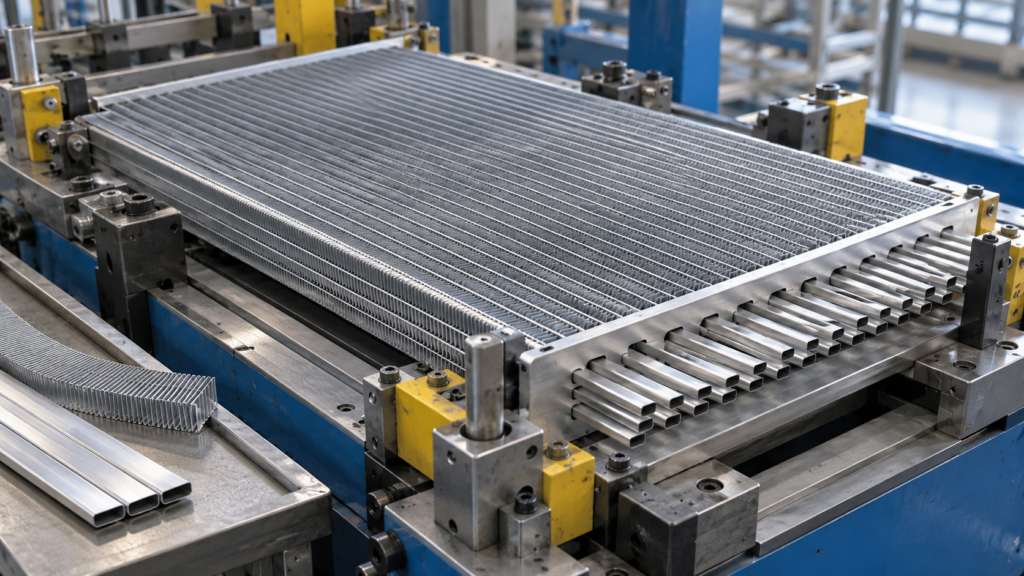
The main example is an aluminum tube-and-fin core joined by controlled atmosphere brazing, or CAB, then fitted with tanks. The core contains coolant tubes, air-side fins, slotted header plates and supporting side members. Tanks connect the coolant circuit to the core.
Other constructions follow different routes. In a mechanically assembled design, tube expansion can establish contact between tubes and fins. Copper-brass radiators require their own material and joining specifications. An equipment maker’s overview of radiator production routes illustrates this distinction.
Start a manufacturing review by confirming the construction shown on the drawing. The word “aluminum” alone does not identify every joint, tank material or production operation.
Automotive Radiator Manufacturing at a Glance
The following overview describes the main stages. Cleaning and flux application may occur at different points depending on the selected route.
| Stage | Result | Main review question |
|---|---|---|
| Material and component preparation | Tubes, fins, headers and other parts ready for assembly | Do they match the approved material and drawing revisions? |
| Core assembly | Components positioned in a fixture | Is the intended geometry maintained before joining? |
| Brazing | Permanent joints in the aluminum core | Is the process qualified for this core configuration? |
| Tank attachment and final assembly | Coolant connections, tanks and specified fittings installed | Are seals, joints and interfaces controlled? |
| Inspection and production testing | Recorded acceptance or rejection | What was measured, under which conditions? |
| Identification and packaging | A protected, traceable shipment | Can received parts be linked to their production records? |
1. Prepare Materials and Form the Components
A manufacturing specification needs to describe more than the overall radiator dimensions. It should identify the tube construction, fin geometry, header configuration, tank material and joining requirements.
Aluminum brazing can use clad material: a structural base alloy carries a thin layer of filler alloy that melts at a lower temperature. Solvay’s aluminum brazing explanation describes how that filler creates the joint while the base components remain solid.
Component preparation then produces the shapes required by the design. Fin strip is formed into its specified profile, while header plates receive openings matched to the tubes. Tubes are supplied in the construction and dimensions selected for the application. These parts may come from different production sites, so the source and revision of each critical component should be clear.
For purchasing review, request a bill of materials tied to the drawing revision. Identify which materials or components need documentary verification and which dimensions need incoming inspection.
If a quotation lists only “aluminum core,” ask for the missing specifications before comparing it with another offer. Otherwise, two prices may describe different products.
2. Assemble the Radiator Core
Core building positions the tubes, fins, headers and side members before they are joined. Fixtures hold the stack and locate the tube ends relative to the header openings. DeWitts’ description of radiator core construction provides a manufacturer’s example of these components and their assembly.
Review both the assembled dimensions and the condition of the interfaces. Useful inspection points include tube seating, fin alignment, header position and the core’s squareness against the approved drawing.
Ask how the factory checks the first assembly after a setup change and how it detects drift during a production run. The answer should identify the feature being checked, the measuring method and the action taken when the result falls outside the agreed limit.
For example, a fixture photograph can help explain how parts are held. A dimensional report from the intended configuration provides more direct evidence that the resulting assembly meets the drawing. Use both when reviewing a new part.
3. Clean, Flux and Braze the Aluminum Core
Brazing joins the prepared core without melting its base components. Surface preparation, filler behavior and heating conditions need to work together.
Surface preparation and flux application
Residual forming oils and other contamination must be addressed before brazing. In a flux-based aluminum process, the flux helps remove the oxide barrier so molten filler can wet the joining surfaces and enter the joint.
Solvay’s NOCOLOK process guide describes flux application to components or assembled units, including wet and electrostatic methods. A wet route also includes drying. The exact sequence should follow the approved manufacturing process.
The useful purchasing question is how coverage and cleanliness are controlled on the actual part. Ask which features require particular attention and what happens when the preparation step is interrupted.
Controlled atmosphere brazing
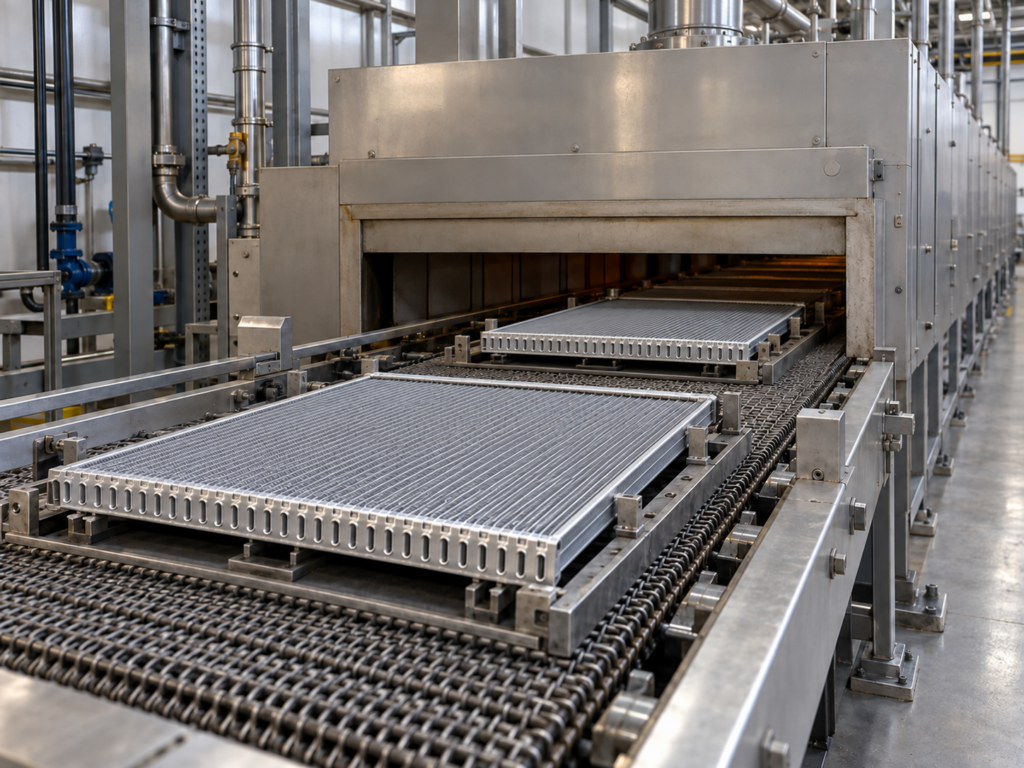
CAB commonly uses a nitrogen atmosphere. The assembly passes through controlled heating and cooling conditions so the filler melts, forms the intended connections and solidifies.
Furnace settings alone do not show the temperature history experienced by the core. Solvay’s Brazing Technical Center describes monitoring component temperatures with thermocouples during the cycle.
Request a process qualification record that identifies the applicable core configuration and loading arrangement. Ask who reviews the results after changes to materials, fixtures or the production route.
A generic furnace temperature taken from an online article is insufficient to define an acceptance specification. The responsible manufacturing and engineering teams need to establish the process window for the selected materials and assembly.
4. Attach Tanks, Seals and Final Components
Once the brazed core has cooled, the remaining assembly route depends on the tank design.
For a plastic-tank radiator, an elastomer seal sits at the tank-to-header interface. The tank is positioned and the header tabs are crimped to retain the joint. Plastic tanks and their seals are installed after the high-temperature core brazing operation. RadiCore’s manufacturing process overview describes this assembly stage.
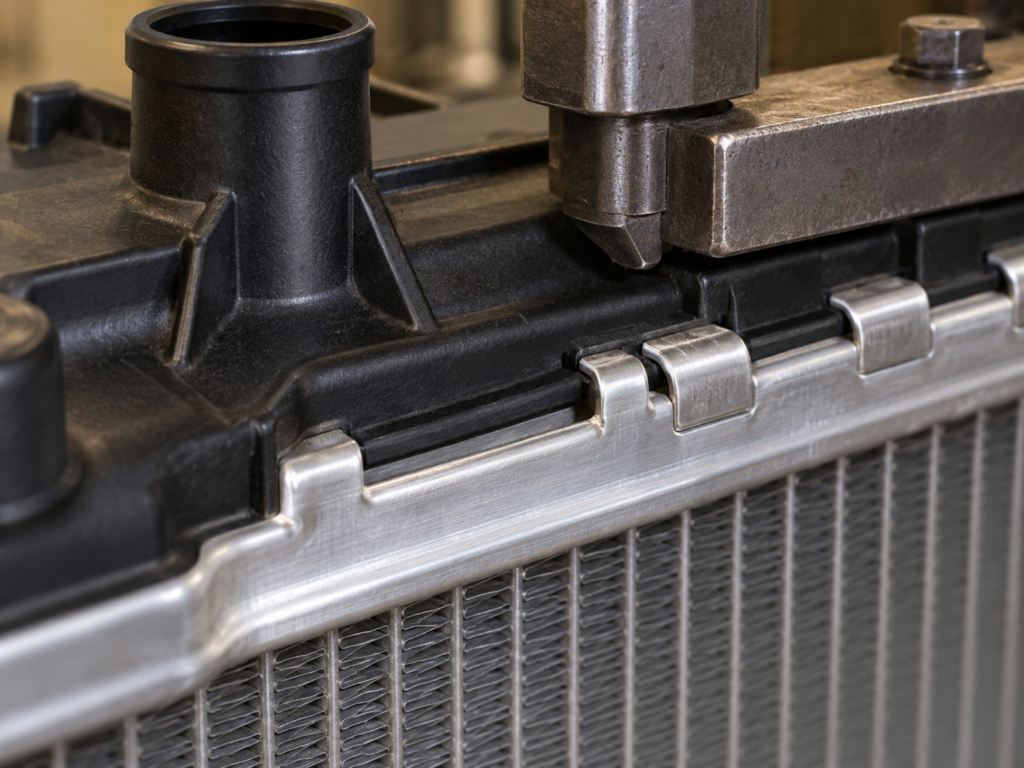
Review the seal specification, seating condition, tank location and agreed crimp inspection method. A general instruction to “crimp tightly” leaves the acceptance criteria undefined.
A metal-tank design can use a different joining route, including welding where specified. DeWitts, for example, describes welding fabricated tanks to its brazed cores. Confirm which joints are brazed and which are welded on the proposed product.
Final assembly may also include mounting brackets, drain features, hose connections or an integrated cooler if the drawing calls for one. Compare the delivered configuration with the approved parts list, including the items that are supplied separately.
A useful final check is to reconcile every vehicle interface with a drawing feature. Record the location, orientation and inspection result instead of relying only on an overall photograph.
5. Inspect the Assembly and Check for Leaks
Inspection should follow the characteristics that matter at each stage. Some features can be measured before joining; others can only be evaluated after brazing or final assembly.
Visual inspection can reveal visible damage or misalignment, but internal joint quality may require a different evaluation. Solvay describes metallographic examination of cut sections to investigate joint geometry and brazing quality. Where that evaluation is required, agree the sampling basis and the feature being examined.
Production leak testing checks the assembly against a defined leakage criterion. Pressure-decay equipment monitors pressure behavior after filling and stabilization; ATEQ explains the underlying test sequence. Tracer-gas systems provide another approach for suitable applications, as described in INFICON’s heat-exchanger leak-testing note.
Before accepting a statement such as “leak tested,” ask for:
- The test method, medium and specified pressure.
- The stabilization and measurement conditions.
- The acceptance limit and its units.
- The production coverage and identification of the tested parts.
- The response to a failed result, including any permitted repair and retest.
Choose the method and limits for the application with the responsible quality team. A brochure’s example leak rate should not automatically become the specification for your radiator.
A production leak-test result does not establish cooling capacity or service durability. Request a separate validation plan for thermal performance and the applicable pressure, temperature, vibration and corrosion exposures. Keep production acceptance records and design validation reports clearly identified.
6. Maintain Traceability Through Packing and Delivery
For a repeat-order program, define how a delivered radiator connects to its manufacturing history. A practical agreement can link the part number and revision to the relevant material batches, process records and inspection results.
Also define what happens when the supply route changes. If core production, tank assembly or final testing moves to another site, the buyer needs a clear change-notification and approval process.
Consider a later order offered at a lower price with the same external dimensions but a different core specification. Ask for the exact differences, the reason for the change and the evidence supporting acceptance before treating it as equivalent to the approved part.
Packaging deserves a documented review as well. Identify the surfaces and interfaces that need protection, agree how open connections are covered, and check how the radiator is restrained in its carton or returnable container.
For the first shipment, compare the received condition with the packing specification. Record discrepancies in a way that lets the supplier connect transport damage or packing errors to the affected shipment.
What Should Buyers Ask Automotive Radiator Suppliers?
The most useful manufacturing discussion follows one part through the proposed supply route. Ask the supplier to show how the drawing, process and inspection records connect.
| Review topic | Evidence to request | Decision it supports |
|---|---|---|
| Product definition | Drawing revision, bill of materials and agreed deviations | Are both parties quoting the same radiator? |
| Manufacturing route | Process flow with responsible production sites | Is each critical operation accounted for? |
| Joining control | Applicable brazing qualification and tank-joint inspection requirements | How will the approved joints be reproduced? |
| Production acceptance | Inspection plan and example completed records | Are acceptance criteria measurable and recorded? |
| Change control | Notification rules, approval responsibility and validation requirements | What must happen before a revised part ships? |
These are suggested review items. Their required depth should reflect the project and customer requirements.
If a supplier cannot share a confidential process parameter, ask what alternative evidence can demonstrate conformance. An agreed report, controlled review or part-specific approval record may answer the purchasing question without requiring disclosure of proprietary recipes.
Discuss Your Radiator Project with HJTC
HJTC works as a supply-chain integration partner. Its automotive radiator range covers aluminum and copper-brass options for applications including passenger vehicles, commercial vehicles and off-highway equipment.
For a project discussion, provide the vehicle application, drawing or reference part, operating conditions, annual demand and required acceptance documents. Identify any customer approval requirements and the intended sample schedule.
Contact HJTC to discuss the proposed supply route and project requirements. Confirm the manufacturing site, process capabilities and supporting records for the specific radiator before production approval.
Frequently Asked Questions
Are automotive radiators brazed or welded?
Both processes can appear in one assembly. A tube-and-fin aluminum core may be furnace brazed, while metal tanks or fittings may be welded later. A plastic-tank radiator typically uses a sealed, crimped tank-to-header joint. The drawing and process flow should identify each connection.
Does every aluminum radiator use CAB?
No. Manufacturing routes vary with the construction. Mechanically assembled cores use a different approach to establish tube-to-fin contact, and CAB is one of several joining technologies used for aluminum heat exchangers. Confirm the route for the proposed part.
Why are plastic tanks attached after core brazing?
The high-temperature brazing operation applies to the metal core. The plastic tanks and elastomer seals are fitted after cooling as part of the tank assembly process.
Does passing a leak test mean the radiator is ready for vehicle approval?
It confirms only the result of the specified leak test. Vehicle approval also depends on the applicable fitment, performance and durability requirements. Check that the test evidence refers to the intended radiator configuration.
What should be supplied before a production order?
Agree the document package with the supplier and your engineering team. A useful starting point is an approved drawing, defined materials, a documented manufacturing route, inspection requirements, relevant validation results and written change-control responsibilities.