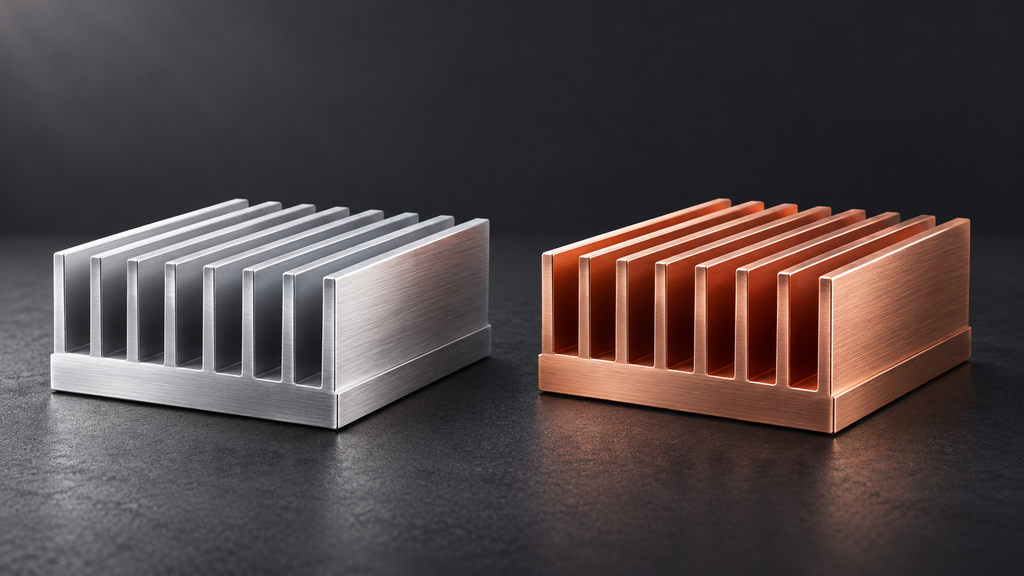
The best heat sink material is the one that meets your temperature limit within the available space, weight and production budget. Aluminum is a practical starting point for many finned heat sinks. Copper deserves consideration when heat must spread from a small source or move through a tightly constrained structure.
The decision becomes more useful when you specify an alloy, temper and manufacturing process. “Aluminum” alone does not define a material property, and a conductivity number does not predict the performance of a finished assembly.
This guide compares copper and aluminum, explains where 6061 and 6063 fit, and shows how to turn material selection into a clear project specification.
Which Heat Sink Material Should You Choose?
For an initial shortlist, use the requirement that is hardest to change:
- An extruded fin profile with a weight limit: investigate 6063 aluminum and a feasible profile geometry.
- A machined thermal component with demanding mechanical features: consider 6061, with strength, tolerances and heat flow reviewed together.
- A small, concentrated heat source: compare copper or a copper spreader with an aluminum baseline.
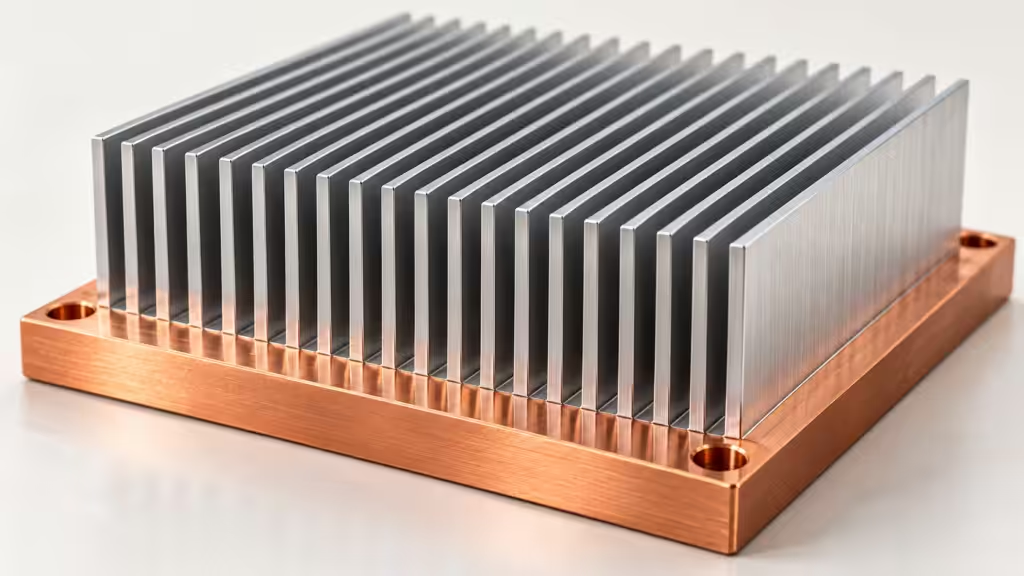
- A large fin area with a local hotspot: evaluate a copper base and aluminum fins as a complete joined assembly.
- Insufficient cooling within the permitted envelope: reassess airflow and the cooling architecture before settling on a different metal.
These are starting points for design review. Qualification still depends on the finished part under the intended operating conditions.
Heat Sink Materials Compared
The following values distinguish specific aluminum tempers from commercially pure copper. They are useful for screening materials, not assigning a heat sink a wattage rating.
| Material and temper | Typical thermal conductivity | Approximate density | Practical starting point |
|---|---|---|---|
| Aluminum 6063-T5 | 209 W/m·K at 25°C | 2.7 g/cm³ | Extruded fin profiles |
| Aluminum 6063-T6 | 201 W/m·K at 25°C | 2.7 g/cm³ | Extruded parts with a specified T6 condition |
| Aluminum 6061-T6 | 167 W/m·K at 25°C | 2.7 g/cm³ | Machined parts and structural thermal components |
| Copper C11000 | About 391 W/m·K at 20°C | 8.91 g/cm³ | Heat spreaders, bases and copper fin structures |
Sources: Hydro for aluminum; the Copper Development Association and Farmers Copper for C11000. Copper conductivity is converted from 226 Btu/(h·ft·°F). Values are typical room-temperature data, not guaranteed acceptance limits for every supplied part.
Thermal conductivity, measured in W/m·K, describes heat conduction within a material. Thermal resistance, commonly expressed in K/W or °C/W, describes the temperature rise per unit of heat flow for a defined path or assembly. A heat sink’s resistance depends on its geometry, interfaces and cooling conditions as well as its material.
For example, the table implies that equal volumes of C11000 copper and these aluminum alloys would have a mass ratio of about 3.3 to 1. That is a useful mounting consideration. It does not establish which design will achieve the lower component temperature.
6061 vs. 6063: Which Aluminum Is Best for Heat Sinks?
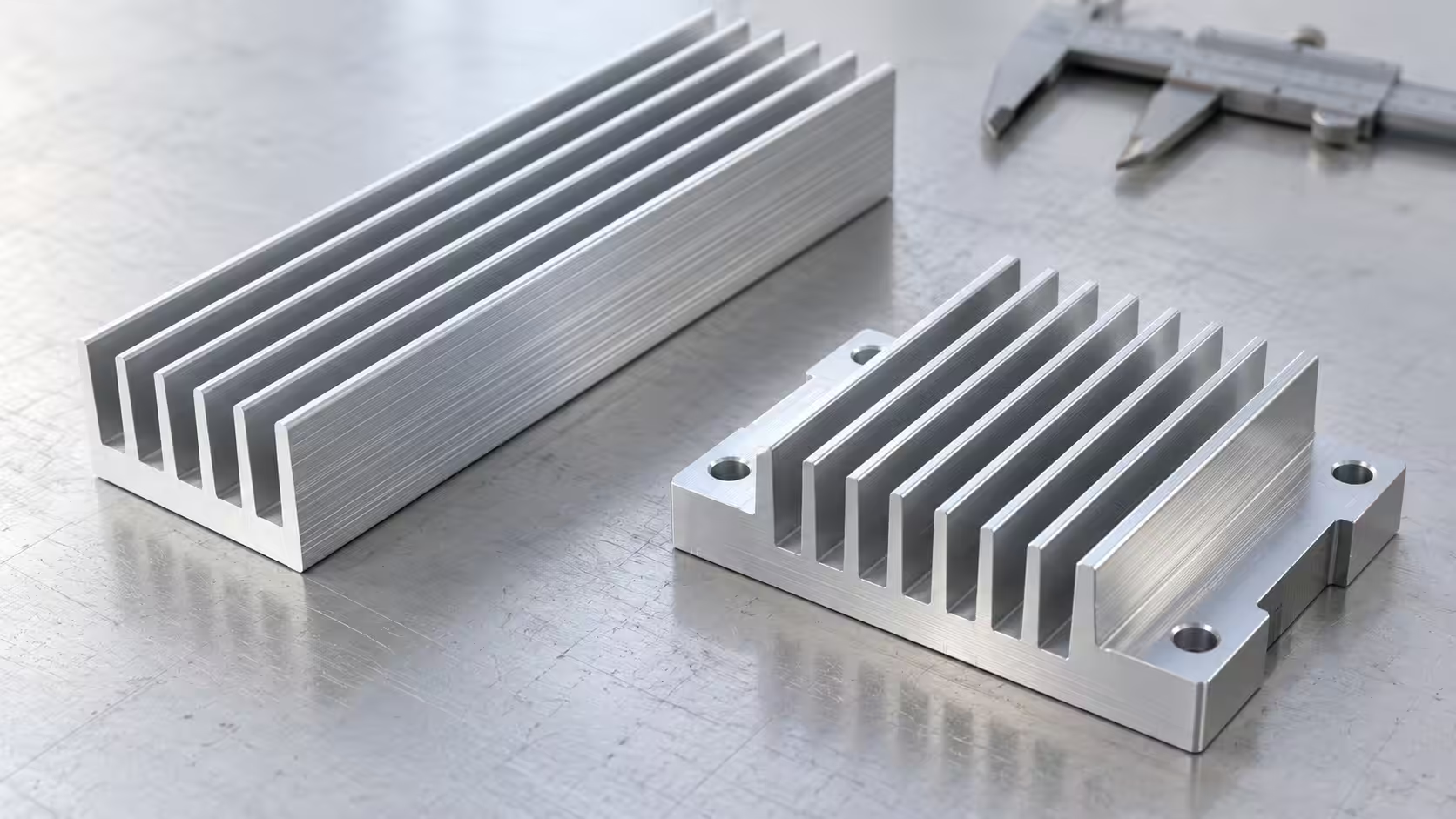
Start with 6063 for an extruded profile
Hydro identifies 6063 with good extrudability and lists heat sinks among its applications. It is a sensible candidate when a repeating cross-section can provide the required base and fins. Its surface finish and anodizing characteristics can also be relevant to exposed components.
Begin the discussion with a cross-section drawing. Ask whether the intended fin height, spacing, base thickness and profile width are feasible together. A familiar alloy designation does not guarantee that every proposed extrusion can be produced consistently.
HJTC’s extruded aluminum heat sinks provide a relevant starting point for projects built around a continuous fin profile. Include the cut length and secondary machining requirements when preparing your inquiry.
Consider 6061 when mechanical features carry more weight
6061 is used for structural applications and can be machined in conditions such as T6 and T6511. Consider it when a thermal component also needs substantial mounting features, structural support or extensive machining. The trade-off should be checked against its lower conductivity relative to the 6063 tempers in the table.
Both alloys can be extruded and machined. The selection is not a rule that assigns one alloy exclusively to extrusion and the other exclusively to CNC work. State the alloy and temper together, then have the supplier review the drawing, material form and final requirements.
Copper vs. Aluminum: When Does Higher Conductivity Help?
Copper’s higher conductivity can be valuable when the design must spread heat away from a concentrated source. A small device mounted near the center of a much wider base presents a different conduction problem from a heat source that covers most of the base. Material comparisons should preserve those source dimensions.
The practical question is where the largest temperature differences occur along the heat path. If spreading through the base is a substantial part of the total resistance, a copper option deserves evaluation. If transfer from the fins to the available air is the main limitation, changing the base metal may leave much of that limitation in place. This is a design inference from the separate conduction and heat-rejection mechanisms, rather than a universal performance ranking.
Compare candidates at the same heat load, inlet-air temperature and permitted fan noise. Keep the mounting method and interface material controlled. Otherwise, an apparent material advantage may actually come from a different airflow rate or contact condition.
Weight also belongs in the comparison. Review how the assembly is supported, whether it loads a circuit board, and how mounting hardware behaves during handling or vibration. For cost, request finished-part quotations covering the specified quantity, tooling, machining, joining, finishing and inspection. Raw-metal price alone leaves important differences unresolved.
When a copper base and aluminum fins make sense
A hybrid arrangement concentrates copper near the heat source while using aluminum for the larger fin structure. It can be worth comparing when the heat-spreading requirement and the allowable mass pull the design in different directions.
Include the joint between the base and fins in that comparison. The joining method, contact quality and durability are part of the thermal design; the two bulk conductivity values cannot describe the assembled heat path. Define the joint and its acceptance criteria with the supplier before treating the concept as a qualified solution.
Match the Material to the Manufacturing Process
A material choice becomes actionable when it fits a production route. Use the table below to frame a drawing review; the routes shown are options to assess, not a statement that every alloy or geometry works with every process.
| Process | Material or construction to discuss | Main design question |
|---|---|---|
| Extrusion | An aluminum profile with integral fins | Can one continuous cross-section meet the thermal and mechanical needs? |
| CNC machining | Aluminum or copper stock; secondary work on a preform | Which surfaces and features actually require tight tolerances? |
| Skiving | Integral fins cut and raised from the base stock | Are the fin geometry and material suitable for the proposed process? |
| Bonded or brazed fins | Separate fins assembled to a base | How will joint quality and thermal performance be controlled? |
| Die casting | A specified casting alloy with integrated features | Does the complete part justify tooling, and what post-machining is needed? |
Do not carry a 6063 conductivity value into a die-cast design. Specify the actual casting alloy and obtain its properties. Likewise, an attractive thin-fin concept should be checked for manufacturing feasibility and handling requirements before it becomes the reference design.
For early prototypes, ask whether the prototype route represents the intended production part. A machined sample may establish fit while leaving production joining, surface condition or geometry unresolved. Record those differences so that a successful prototype test is interpreted correctly.
Surface Finish, Contact and Corrosion
Anodizing can increase the emissivity of an aluminum surface, helping it reject heat by radiation. Its benefit depends on the operating conditions and how much radiation contributes to cooling. A black finish is not evidence of higher bulk thermal conductivity, and color alone does not establish emissivity.
Specify the finish together with the thermal contact areas. Review coating thickness, masking, base flatness, interface material and mounting pressure. The contact between a component and a heat sink introduces resistance of its own, so an improved bulk material can still be undermined by a poor interface.
Also identify moisture exposure and neighboring metals. Hydro’s alloy guidance warns about galvanic corrosion when dissimilar metals are electrically connected in a corrosive environment. Review fasteners, protective treatments and the intended service conditions rather than assuming that a dry indoor design transfers unchanged to an outdoor enclosure.
A Practical Material-Selection Workflow
1. Define the temperature limit and operating point
Write down the continuous and peak heat loads, heat-source footprint, allowable temperature and cooling-air inlet temperature. Identify whether the component limit is a junction, case or another specified temperature. Those reference points cannot be exchanged without accounting for the intervening thermal path.
Use the air temperature entering the heat sink, including enclosure heating where relevant. Record whether the product must operate in more than one orientation and which configuration represents the difficult cooling condition.
2. Estimate the available thermal-resistance budget
Consider this illustrative screening example, with all significant heat assumed to leave through the heat sink at steady state:
- Heat load: 80 W.
- Maximum permitted component case temperature: 85°C.
- Air temperature entering the heat sink: 45°C.
- Assumed case-to-sink interface resistance: 0.08 K/W.
The available case-to-air resistance is:
(85 − 45) / 80 = 0.50 K/W
After allocating resistance to the interface, the heat sink must provide:
Heat-sink-to-air resistance ≤ 0.50 − 0.08 = 0.42 K/W
This leaves no additional design margin. Set that margin before approving a candidate. The calculation follows a simplified series thermal path; parallel heat paths and transient loads may require a more detailed model. The inputs are hypothetical, not an HJTC test result or product rating.
3. Compare complete candidates
Build a shortlist that reflects the real constraint. For example, compare an aluminum extrusion, a copper-base assembly and a revised aluminum geometry within the same permitted envelope. Document any differences in mass, airflow requirement, mounting or manufacturing route.
Ask for thermal-resistance data with its conditions attached. Relevant details include airflow direction, orientation, heat-source size, interface, mounting and temperature reference. A single resistance value without those conditions is insufficient for a meaningful comparison.
Where possible, compare both temperature and the resources needed to achieve it: fan power, noise, mass and finished-part cost. A useful selection record explains why the chosen candidate fits the product, rather than merely naming the metal with the highest conductivity.
4. Validate the part in the intended assembly
Prepare a test configuration that represents the enclosure, air path, surrounding obstructions and mounting arrangement. Define the operating points and acceptance limits in advance. Include the conditions that could change between a bench prototype and the finished product.
Keep a record of the material designation, drawing revision, surface treatment, interface material and assembly procedure. If a supplier later proposes a material or process substitution, review which parts of the original evidence remain applicable. This makes the material decision traceable through production changes.
When Graphite, Heat Pipes or Liquid Cooling Enter the Decision
Some materials and assemblies solve a more specific problem than a conventional metal fin block.
Graphite sheets can spread heat effectively along the sheet. Panasonic specifies its PGS conductivity in the X–Y direction. Check both the direction and product thickness before comparing that value with a bulk-metal number. A thin spreader also needs a path to a surface that can release the heat.
Heat pipes and vapor chambers are assemblies that transport or spread heat; they should be evaluated as working devices with operating limits. They can form part of a fin assembly, but their performance cannot be represented by assigning one ordinary solid-material conductivity to the whole cooler.
Liquid cold plates move heat into a circulating fluid. If the air-cooled envelope cannot satisfy the requirement, discuss a cold plate together with the coolant, flow, pressure drop and the rest of the cooling loop. Review all wetted materials for compatibility with that loop. [13]
HJTC’s liquid cold plates are a separate project route to discuss when the cooling architecture needs to change.
Prepare a Custom Heat Sink Brief for HJTC
HJTC’s product scope includes heat sinks, liquid cold plates and industrial aluminum profiles. Its project approach connects thermal requirements with manufacturability, from development through production planning.
For a material-selection inquiry, send the requirements that determine the choice:
- Thermal inputs: heat-source dimensions and locations, sustained and peak heat loads, temperature limits and inlet-air conditions.
- Mechanical inputs: available envelope, mass limit, mounting points, contact surfaces, keep-out areas and critical tolerances.
- Cooling conditions: natural or forced airflow, intended orientation and available fan information; coolant conditions for a cold plate.
- Production inputs: prototype quantity, expected production quantity, preferred material and temper, finish and required documentation.
- Verification inputs: relevant drawings or CAD, existing test observations and the proposed acceptance criteria.
If a material is already mandatory, state why. A customer drawing, mechanical requirement or approved material list may constrain the available options. If the material is open, describe the performance target so that the discussion can consider geometry and manufacturing route together.
For an extruded concept, include a cross-section and finished length. For an assembled design, identify the proposed base, fins and joining requirements. These details make the inquiry more useful than a request for the “best metal.”
Discuss Your Heat Sink Material and Design Requirements
Send HJTC your drawing, heat load and space constraints to begin a discussion about a suitable heat sink or cold-plate approach.
Frequently Asked Questions
Is copper always better than aluminum for a heat sink?
Copper has higher conductivity than the aluminum alloys compared here, but a finished heat sink also depends on heat spreading, interfaces and heat rejection. Compare the complete designs under equivalent conditions, including the mass and cooling resources each requires.
What is the best aluminum alloy for an extruded heat sink?
6063 is a useful starting candidate because of its extrudability. Specify the temper and review the profile with the supplier. The best choice still depends on the actual geometry, mechanical requirements and available manufacturing route.
Does black anodizing make an aluminum heat sink cooler?
It can help when increased surface emissivity makes a meaningful contribution to heat rejection. The outcome depends on the complete operating condition. Do not treat the black appearance as a guaranteed temperature reduction or a change in the alloy’s bulk conductivity.
Can I choose a heat sink material from wattage alone?
Wattage needs context. Define the heat-source area, temperature limit, inlet-air conditions, available space and cooling arrangement. Those inputs establish the target that candidate materials and structures must meet. Two devices dissipating the same power can need very different heat sinks.